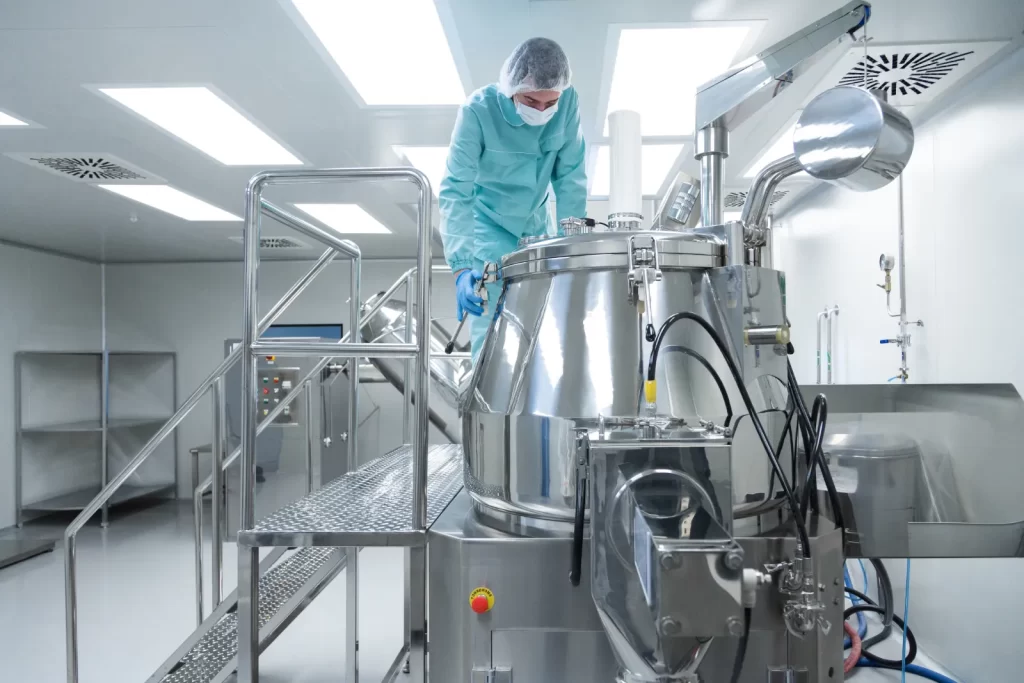
A very large mass’s health and wellness depend upon how a pharma manufacturing firm maintains its space. It is supposed to be a carefully calibrated space where composure is not housekeeping theater. It is an engineered discipline. One tiny mistake with Equipment Design, contamination prevention protocols, or measurement, and thousands of lives can be affected, along with the business itself.
Filtration alone does not preserve purity. HEPA banks capture particulates, yes, but filters cannot compensate for flawed hardware. The machinery, frames, housings, carts, vessels, and weldments inside the suite quietly determine whether the room behaves like a sanctuary or a source of contamination. Every joint either safeguards sterility or subtly sabotages it.
Here is the uncomfortable reality most teams discover after a failed batch:
Poor design cannot be scrubbed away. A pharma space cannot compromise with contamination hazard, misfiring airflow, or any unreliable tool.
For fabrication specialists serving pharmaceutical facilities exclusively, workmanship is not cosmetic. It is consequential. The integrity of a weld today can protect thousands of doses tomorrow.
A cleanroom is less a room and more a living system.
Air currents, material finishes, operator traffic, and equipment geometry interlace constantly, like gears in a watch. Misalign one component, and the mechanism loses rhythm.
Picture a clear mountain stream. Introduce a few jagged stones and the water churns, eddies appear, sediment gathers. The same physics apply inside a controlled environment. Awkward equipment shapes disturb laminar flow, generate turbulence, and invite particles to settle where they never should.
Poor design announces itself through chaos.
Thoughtful design becomes almost invisible.
In pharmaceutical manufacturing, invisibility is the mark of excellence.
Contamination seldom arrives with drama. It creeps.
That is enough to invalidate a batch.
Surface texture, joint configuration, and base material directly influence particle release. Roughness sheds. Threads harbor debris. Mixed alloys corrode. Dead spaces collect residue like forgotten corners in an attic.
These are not theoretical hazards; they are routine consequences of careless fabrication.
Dead legs and shaded cavities are especially treacherous. Add warmth and moisture and you have effectively constructed a nursery for microbes. Hygiene becomes reactive instead of preventive.
Competent fabrication removes those risks before installation ever begins. Seamless. Continuous. Reachable.
If a surface cannot be cleaned in a single, uninterrupted pass, it does not belong in a pharmaceutical cleanroom.
Agencies do not judge compliance solely by binders and SOPs. They scrutinize equipment.
FDA 21 CFR Part 211 and EU GMP Annex 1 both note that processing equipment be cleanable, maintainable, and contamination-resistant by design. Here, hygienic construction is not a suggestion – it is a mandate.
Inspectors inevitably notice:
Each flaw becomes a notation. Enough notations become findings.
Passing an audit often hinges on millimeters of craftsmanship. Compliance, quite literally, is built into the steel.
This discussion is not abstract metallurgy.
In practice, an unfinished seam can accumulate powder, trigger out-of-specification results, and condemn an entire production lot. Weeks evaporate. Costs escalate. Schedules collapse.
Recalls rarely stem from dramatic failures. They originate from tiny oversights. When dosages are measured in milligrams, even microscopic contamination carries weight.
Well-designed equipment shields more than processes – it safeguards patients.
Within pharmaceutical plants, stainless steel is almost a dialect of its own. 316L stainless steel fits into pharma so perfectly, as it keeps it a million miles away from corrosion. The metal tolerates harsh sanitizers, minimizes particulate shedding, and maintains structural stability over decades. Electropolishing refines the surface further, reducing microscopic peaks where residues might cling. Passivation enhances corrosion resistance at the molecular level.
The result is not merely durability. It is predictability. And predictability is the backbone of regulated manufacturing.
Particles frequently originate from the equipment itself. Eliminate that source and the room breathes easier.
Effective strategies include:
TIG and orbital welding, followed by meticulous finishing, create surfaces that behave like uninterrupted planes. If a joint feels abrasive to the fingertips, it is a contamination trap under magnification.
Cleaning should not resemble a treasure hunt.
CIP and SIP-compatible assemblies allow comprehensive sanitation without dismantling half the line. Sloped faces encourage drainage. Quick-release components accelerate manual access.
Contact surfaces typically target Ra ≤ 0.8 µm. Below that figure, residues struggle to adhere. Above it, cleaning time multiplies.
Smoothness is not aesthetics – it is efficiency.
Cleanrooms rely on disciplined airflow, usually unidirectional. Interrupt that stream and particles wander.
Equipment must be positioned to avoid blocking HEPA discharge, minimize turbulence, and prevent stagnant pockets. Bulky or poorly proportioned structures create swirling eddies that trap contaminants like leaves in a gutter.
Thoughtful placement preserves the intended flow path and sustains classification performance.
Humans remain part of every process.
When equipment is awkward or unintuitive, mistakes proliferate. Proper working heights, logical layouts, and safety interlocks reduce fatigue and align with OSHA and ISO 14644 expectations. Good ergonomics quietly diminish risk without fanfare.
Comfort, in this context, equals consistency.
Pharmaceutical operations evolve quickly – new products, new volumes, new technologies.
Modular panels and mobile equipment allow facilities to pivot without demolition. Systems expand rather than restart. Flexibility protects capital and reduces downtime.
Rigid designs age poorly. Adaptable ones endure.
Unsuitable Materials – non-stainless metals corrode and shed; porous plastics harbor microbes.
Inferior Welding – rough seams and exposed threads trap contaminants.
Poor Drainage – pooled liquid becomes a microbial incubator.
Airflow Neglect – obstructed filters and chaotic currents spread particles.
Individually minor, collectively disastrous.
Ability Fabricators approaches fabrication with a pharmaceutical lens from the outset. Equipment is conceived specifically for regulated environments, not retrofitted after the fact.
3D modeling and CFD simulations validate airflow behavior before metal is cut.
316L stainless steel is standard practice. Electropolishing, passivation, and Ra verification are routine steps, not add-ons.
Full traceability, heat lot data, and complete IQ/OQ/PQ packages accompany every build, simplifying validation and audits.
The objective is straightforward: equipment that installs smoothly and performs quietly.
Improvements are tangible; particle counts decrease. Cleaning cycles shorten. Audit observations decline. Downtime contracts. Over time, the return on investment becomes unmistakable – longer equipment life, fewer disruptions, lower risk.
Sound design pays dividends silently.
Lately, IoT and AI operations have taken many fields under their wide and spreading wings. Pharma is also one of them. Being able to build a pharma facility that is capable to smoothen its operations with enabled equipment would be a notable achievement and a milestone in itself. It is more than crucial to have such a set of equipment that lets your pharma entity thrive in the emerging tech-rich era.
Because poorly designed equipment can generate particles and contamination that compromise product sterility.
It resists corrosion, withstands harsh sanitizers, and offers smooth, cleanable surfaces.
An electropolished finish with low Ra values helps prevent residue buildup and eases cleaning.
Rough or exposed welds trap particles and microbes, while smooth, continuous welds minimize risks.
They are stagnant areas where liquids or residues collect and encourage microbial growth.