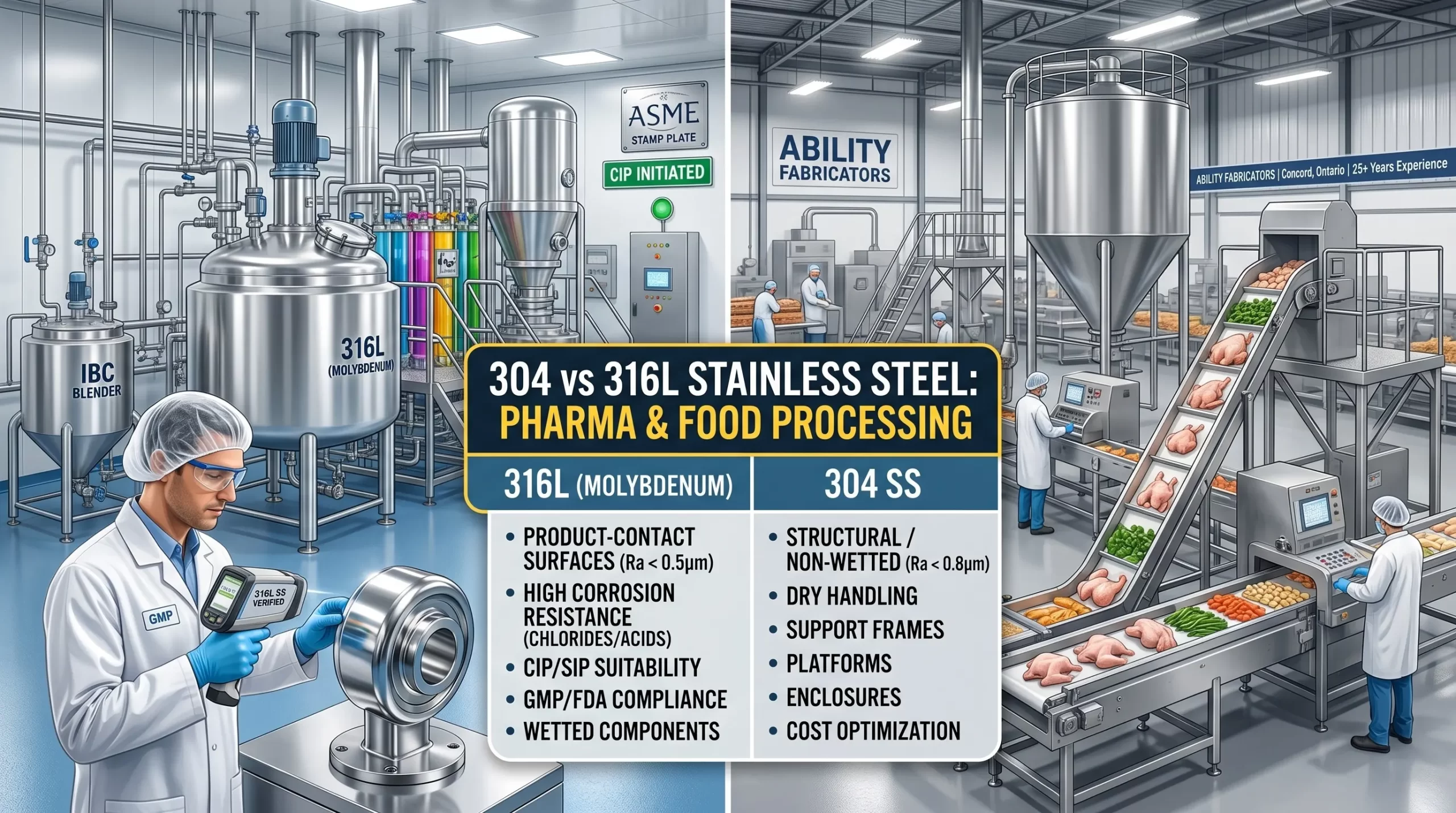
Pick the wrong stainless steel grade, and you are not just looking at a materials cost problem, you are looking at contamination risks, failed audits, and equipment that needs to be torn out and rebuilt. That’s a reality we’ve seen more than once in our 25+ years fabricating GMP-compliant equipment for pharma, food, and chemical industries from our Concord, Ontario facility. When it comes to 304 vs 316L stainless steel pharma food processing, the two grades look almost identical on the surface. Underneath, they behave very differently – and choosing between them correctly is one of the most consequential decisions in regulated equipment design.
Understanding Stainless Steel Grades: What Do "304" and "316L" Actually Mean?
The Austenitic Stainless Steel Family - A Quick Overview
Pick the wrong stainless steel grade, and you are not just looking at a materials cost problem, you are looking at contamination risks, failed audits, and equipment that needs to be torn out and rebuilt. That’s a reality we’ve seen more than once in our 25+ years fabricating GMP-compliant equipment for pharma, food, and chemical industries from our Concord, Ontario facility. When it comes to 304 vs 316L stainless steel pharma food processing, the two grades look almost identical on the surface. Underneath, they behave very differently – and choosing between them correctly is one of the most consequential decisions in regulated equipment design.
Chemical Composition - What's Actually Different?
Here’s where it matters:
|
Property |
304 SS |
316L SS |
|
Chromium Content |
~18% |
~16–18% |
|
Nickel Content |
~8% |
~10–14% |
|
Molybdenum |
None |
2–3% |
|
Carbon Content |
≤0.08% |
≤0.03% |
|
Chloride Resistance |
Moderate |
High |
|
Weld Zone Stability |
Good |
Excellent |
|
CIP/SIP Suitability |
Limited |
Preferred |
|
Electropolishing Response |
Good |
Excellent |
|
Relative Cost |
Lower |
20–40% higher |
|
Typical Application |
Structural / Non-wetted |
Product-contact / Wetted |
The single biggest differentiator is molybdenum. That 2–3% addition in 316L dramatically improves resistance to pitting and crevice corrosion in chloride-rich environments. The “L” designation is equally important. It stands for low carbon (≤0.03%), which prevents a damaging reaction called carbide precipitation at weld heat-affected zones. When you’re building equipment that will be welded, cleaned repeatedly, and subjected to regulatory scrutiny, both of those distinctions have real consequences.
Corrosion Resistance: Where 316L Pulls Ahead
Chloride Environments and Pitting Corrosion
Chlorides show up everywhere in pharma and food environments, including salt, NaCl-based sanitizers, saline IV solutions, and brined food products. The metal 304 develops localized pitting corrosion after multiple chloride exposures, which damages its surface and forms entry points for contamination. 316L stainless steel pharmaceutical equipment maintains its passive oxide layer through molybdenum, which protects against all types of attacks. The specification for 316L remains effective when you handle saline solutions together with chlorinated sanitizers in environments near the ocean.
Crevice Corrosion and Weld Integrity in GMP Equipment
The welds serve as the most defenseless sections that exist in any structure made from fabricated components. The steel in the heat-affected zone becomes susceptible to sensitization when heat is applied because chromium moves to grain boundaries. This creates chromium-poor areas that experience increased corrosion. The low carbon content in 316L stainless steel fully stops this chemical reaction from occurring. GMP stainless steel fabrication requires welds to maintain their hygienic integrity, which equals their weld integrity.
When 304 Corrosion Resistance Is Adequate
Not every component needs 316L, and specifying it where it isn’t required wastes the budget without adding compliance value. For non-wetted structural components, including outer frames, platforms, catwalks, equipment enclosures operating in low-chloride environments, 304 stainless steel food processing applications are entirely appropriate. The deciding question is always the same: does this surface contact the product or the cleaning solution?
GMP, FDA, and Regulatory Compliance - What the Standards Say
cGMP Requirements for Product-Contact Surfaces
FDA 21 CFR Part 211 (pharmaceutical) and Part 117 (food) both require that product-contact materials be non-reactive, non-additive, and non-absorptive. EU GMP Annex 1 and EHEDG guidelines carry similar performance-based language. Neither regulation names 316L explicitly, but 316L stainless steel pharmaceutical equipment has become the accepted industry standard for product-contact surfaces precisely because it consistently satisfies those performance criteria with the lowest interpretive risk during an audit.
Surface Finish Requirements (Ra Values) and Material Interaction
Grade selection and surface finish are closely linked. The surface roughness requirement for food-contact surfaces stands at 0.8 µm or better, while pharmaceutical surfaces need to achieve 0.5 µm or better. Electropolishing serves as the best method to obtain and preserve these finishes because 316L responds better to electropolishing than 304, which results in a tighter and more consistent passive layer that can be easily validated. Ability Fabricators performs electropolishing inside their facility, which serves as a fundamental element of their GMP stainless steel fabrication work to ensure surface finish requirements are met.
Material Traceability - MTRs and PMI Testing
In regulated fabrication, the paper trail is as important as the material itself. Material Test Reports (MTRs) confirm the chemical and mechanical properties of the steel at procurement. Positive Material Identification (PMI) testing verifies grade at critical points after fabrication, particularly at welds and cut surfaces. Ability Fabricators provides full MTR documentation on every project as standard, not as an add-on.
CIP and SIP Compatibility - The Grade That Survives Your Cleaning Protocols
Why Cleaning Chemistry Drives Material Selection
The CIP systems maintain equipment operation by running hot caustic solutions with NaOH and acidic rinses containing nitric acid, phosphoric acid, and chlorinated sanitizers through multiple repeated cycles, which continue throughout the equipment’s life span. The three chemical substances attack metal surfaces, while chlorinated agents stand as top-performing sanitizers within the industry. The 316L stainless steel pharmaceutical equipment shows excellent resistance to multiple CIP cleaning cycles because it maintains its surface quality through thousands of cleaning cycles without developing pitting or crevice corrosion that would damage its hygienic surface.
SIP Steam Cycles and Thermal Stress
Sterilize-in-Place cycles introduce a new aspect because they require steam temperatures above 121°C, which combine with the same intense chemical conditions. The process of thermal cycling in welded assemblies that experience sensitization leads to growing damage that gets worse with each cycle. The low carbon content in 316L steel decreases the risk of sensitization. This makes it the best material for equipment that needs regular SIP cycles during its extended service life.
Practical Guidance from the Shop Floor
When we’re designing CIP-compatible tanks, blenders, and pressure vessels for pharma clients, we specify 316L for all wetted surfaces as standard practice. It’s not a premium option – it’s the baseline. That’s a call we make based on 25 years of seeing what happens to equipment that was underspecified.
Application-by-Application Breakdown - 304 or 316L?
|
Application |
Recommended Grade |
Key Reason |
|
Pharma mixing tanks, IBCs, blenders, pressure vessels |
316L |
Product contact, CIP/SIP exposure |
|
High-acid food processing (tomato, citrus, dairy, brine) |
316L |
Chloride and acid resistance |
|
Dry ingredient handling, structural platforms |
304 |
No product contact, low chloride exposure |
|
Nutraceutical active ingredient contact |
316L |
Regulatory alignment, cleaning protocols |
|
Cosmetic / nutraceutical packaging, structural frames |
304 |
Non-contact, cost optimization |
|
Chemical processing (aggressive reagents) |
316L or specialty alloy |
Process-specific – consult engineering |
Pharmaceutical Processing Equipment
All product-contact surfaces in pharma, including mixing tanks, IBCs, V-blenders, double cone blenders, IBC bin blenders, and pressure vessels, should be 316L stainless steel pharmaceutical equipment as a default. Ability Fabricators builds its full GMP-compliant blender and IBC line to this standard.
Food & Beverage Processing Equipment
High-acid foods, brine, and dairy all require 316L. 304 stainless steel food processing grade is appropriate for dry ingredient handling and structural components where chloride exposure is minimal and no product contact occurs.
Nutraceutical and Cosmetic Manufacturing
The same logic applies: 316L for anything touching the active ingredient; 304 for structural and packaging-adjacent components where it’s justified by the process.
Cost Comparison - Is 316L Worth the Premium?
Raw Material and Fabrication Cost Differences
316L carries a 20–40% raw material premium over 304, driven by its higher nickel and molybdenum content. On a large fabrication project, that’s a real number at the procurement stage. Weighed against the cost of a contamination event, a failed audit, or an unplanned equipment replacement, it’s not a difficult calculation.
Total Cost of Ownership (TCO) Perspective
Across a full equipment lifecycle, 316L consistently delivers lower total cost in demanding environments. Longer service life, fewer replacements, cleaner audits, reduced downtime – they all add up. The material premium paid upfront is usually recovered within the first major service interval that doesn’t happen.
Hybrid Approaches Used in Real Fabrication Projects
The most cost-effective approach is a deliberate hybrid: 316L for all wetted, product-contact, and CIP-exposed surfaces and 304 stainless steel food processing grade for structural frames, platforms, and non-contact enclosures. Ability Fabricators engineers these hybrid material specifications routinely, optimizing procurement cost without putting compliance surfaces at risk.
How Ability Fabricators Selects the Right Grade for Your Project
Every project begins with a structured process: client consultation, process chemistry review, regulatory requirement mapping, and grade specification, before anything is cut. Our in-house engineering team at the Concord, Ontario facility brings that discipline to every project, whether it’s a single custom tank or a full facility equipment package. For stainless steel material selection Toronto and across North America, we provide full MTR documentation, PMI testing, and a certification portfolio that includes CWB, ASME, TSSA, CSA B51, ISO 9001, and GMP Standard Compliance. Laser cutting, CNC milling, certified welding, electropolishing, and full assembly – all under one roof, all on one quality system.
Conclusion - Making the Right Grade Decision for Your Facility
316L stainless steel pharmaceutical equipment is the industry standard for product-contact surfaces, CIP/SIP systems, and chemically aggressive environments. 304 stainless steel food processing grade is the right, cost-effective choice for structural and non-wetted applications. The mistake is applying one where the other is required, and in regulated manufacturing, that mistake has a way of surfacing at the worst possible moment.
With 25+ years of experience and 150+ combined years of team expertise, Ability Fabricators brings engineering discipline and regulatory fluency to every material decision.
Have a project requiring precision material selection? Contact our engineering team for a consultation.
Frequently Asked Questions
Not all – but it is required for all product-contact and CIP/SIP-exposed surfaces. Structural, non-wetted components such as frames and platforms can appropriately use 304 without compromising compliance.
Yes, in the right applications. 304 stainless steel food processing use is appropriate for dry ingredient handling, structural equipment, and low-chloride environments. For high-acid foods, brine, dairy, or anywhere chlorinated sanitizers are used, 316L is required.
“L” stands for low carbon – a maximum of 0.03% versus 0.08% in standard 316. This prevents carbide precipitation at weld zones (sensitization), preserving corrosion resistance wherever welded joints face repeated chemical or thermal exposure, which is nearly everywhere in GMP stainless steel fabrication.
FDA 21 CFR Parts 211 and 117 and EU GMP Annex 1 specify performance requirements, not specific grades by name. 316L has become the accepted standard for product-contact surfaces because it reliably meets those requirements. When in doubt, consult your regulatory affairs team alongside your fabricator’s engineers.
Yes! Full MTR documentation and PMI testing traceability are standard on every project.
Food-contact surfaces typically require Ra 0.8 µm or finer. Pharmaceutical surfaces require Ra 0.5 µm or better. Ability Fabricators provides in-house electropolishing to meet and exceed these requirements as part of every GMP stainless steel fabrication project.