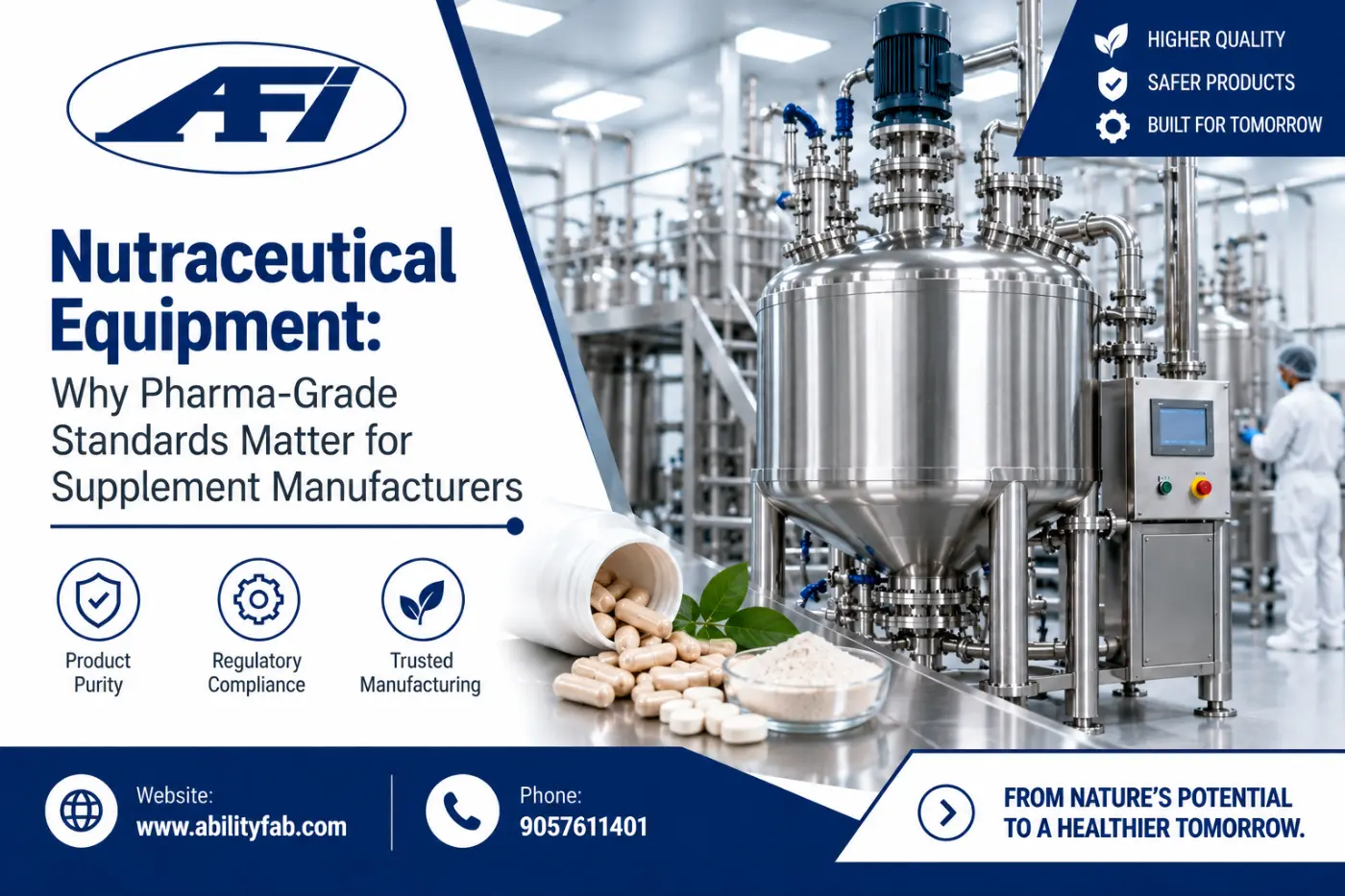
The natural health product market across North America is expanding rapidly. Consumers rely heavily on vitamins, minerals, herbal extracts, and dietary supplements to support their wellness goals. However, this growth brings intense regulatory oversight. Health Canada and the U.S. FDA have raised quality expectations, requiring supplement makers to adopt sanitary production standards matching those of the pharmaceutical sector.
For plant managers and process engineers, selecting nutraceutical equipment goes far beyond upfront equipment costs. The machinery on your floor directly dictates batch purity, active ingredient consistency, and whether your line passes its next audit. Sourcing pharma-grade stainless steel equipment is no longer an optional upgrade – it is how modern supplement facilities protect their license to operate.
Why Nutraceutical Manufacturing Needs Pharma-Grade Equipment
The line between supplement processing and traditional drug manufacturing is closing, particularly regarding cleanability, equipment validation, and contamination control.
Contamination Control & Purity Standards
Supplements are ingested daily, often in high doses. A single quality failure – whether caused by cross-batch powder carryover, microbial growth, chemical residues from sanitizers, or microscopic metal shavings from wearing machinery – presents severe health risks and can trigger immediate product recalls.
Pharma-grade hardware eliminates these failure points:
- Non-porous contact surfaces: High-grade stainless steel resists bacterial buildup and withstands aggressive daily chemical washdowns.
- Crevice-free fabrication: Continuous, ground welds eliminate tiny gaps, pits, and unsealed joints where powders or liquids collect and spoil.
- CIP/SIP integration: Systems built for Clean-In-Place (CIP) and Steam-In-Place (SIP) protocols allow crews to run repeatable, automated sanitation cycles between production runs.
Ability Fabricators
Regulatory Overlap with Pharma (Health Canada & FDA)
In Canada, natural health products (NHPs) are governed by Part 3 of the Natural Health Products Regulations. Updated Health Canada Good Manufacturing Practice (GMP) guidance states that processing machinery must be explicitly suitable for its intended function, easy to sanitize, and backed by clear validation records.
Auditors look for more than a tidy shop floor; they require verifiable proof of sanitary design. Supplement makers must demonstrate that their nutraceutical manufacturing equipment prevents cross-contamination by design, supported by documented cleaning and maintenance procedures.
Key Equipment for Nutraceutical Production
A compliant facility relies on specialized sanitary processing units engineered to handle sensitive active ingredients without altering their strength or stability.
Blenders & Mixers
Mixing equipment sits at the center of your processing line. If your blend is inconsistent, finished tablets, capsules, or liquid drops will fail to deliver their stated label claims.
Ability Fabricators engineers custom supplement manufacturing equipment tailored to your formulation requirements:
Ability Fabricators
- Dry Powder Blenders (V-Blenders, Double Cone, and IBC Bin Blenders): Deliver uniform, low-shear blends of active botanical powders, vitamins, and fine excipients without generating friction heat that degrades sensitive compounds.
- Liquid & Emulsion Mixers: Feature variable-speed drives and high-shear impellers to blend oils, solvents, and liquid extracts completely, preventing chemical stratification or residue accumulation.
Containers & Cleanroom Components
Product purity depends on the entire processing suite. To prevent cross-contamination during transfer and staging, high-spec processing plants rely on:
- Sanitary Transfer Panels & Hoppers: Protect product flow when moving materials between cleanroom suites.
- Cleanroom Parts Carts, Sinks, & Wash Station Doors: Fabricated specifically to withstand harsh sanitizing agents and maintain environmental boundaries.
- Stainless Catwalks & Platforms: Built with sanitary handrails and non-slip surfaces so operators can safely inspect hoppers without introducing exterior dust or debris into open product zones.
Common Mistakes in Sourcing Nutraceutical Equipment
A frequent mistake growing supplement companies make is assuming basic food-grade or commercial industrial hardware is sufficient for their facility. Saving money upfront on lower-tier machinery usually leads to operational bottlenecks:
- Hygiene & Harborage Risks: Standard commercial equipment often includes exposed bolt threads, rough mechanical welds, and unsealed joints where raw powders collect and breed bacteria.
- Failed Regulatory Audits: Non-compliant machinery stands out to inspectors during Health Canada or FDA audits, leading to warning letters, product holds, or mandatory plant shutdowns.
- Potency Failures: Sub-standard vessel geometry or impellers lead to erratic batch blending, causing finished lots to fail assay and potency testing.
- Higher Total Ownership Costs: Upfront savings on basic machinery are quickly erased by longer washdown cycles, high scrap rates, frequent repairs, and early equipment replacement.
Working with a Pharma-Grade Fabricator
Sanitary equipment design requires more than general metalworking. You need a fabrication partner who understands regulatory compliance and translates GMP rules into functional hardware.
With over 150 years of combined experience, Ability Fabricators is one of Canada’s premier custom stainless steel fabricators. We design and build nutraceutical equipment to match the strict standards of regulated sectors:
The Fabricator+ 1
- Sanitary Design Practices: Continuous ground welds, radiused internal corners, self-draining surfaces, and sanitary tri-clamp fittings ensure fast, complete washdowns.
- Material Traceability (304 vs. 316L): We fabricate using certified 304 and 316L stainless steel. For processing lines exposed to acidic botanicals, active salts, or harsh sanitizing chemicals, 316L provides superior defense against pitting and corrosion.
Ability Fabricators - Turnkey Documentation Packages: We supply full Material Test Reports (MTRs), finish certifications (Ra testing), and detailed weld logs so your quality team is prepared for audit inspections.
- Local Support: Headquartered in Concord, Ontario (GTA), we serve clients across Ontario and North America with reliable lead times and custom engineering support.
To see how our team can help upgrade your production lines, explore ournutraceutical equipment fabrication capabilities.
Ability Fabricators
Conclusion
As regulatory standards tighten across the supplement industry, running standard commercial machinery introduces significant risk. Upgrading to pharma-grade stainless steel equipment is the most practical strategy to secure product integrity, satisfy Health Canada and FDA auditors, and protect your brand’s reputation.
Partnering with an accredited fabricator ensures your machinery is built to perform consistently, clean thoroughly, and pass regulatory inspections for years to come.
Ability Fabricators
Do not let improper equipment compromise your product quality. Contact Ability Fabricators today to review your facility specifications or request a project quote.
Faqs
Pharmaceutical equipment has traditionally required stricter validation documentation, mill-to-plant material traceability, and finer surface finishes (such as polished 15 Ra finishes). Today, leading supplement producers choose these same standards for their nutraceutical manufacturing equipment to guarantee purity and avoid compliance issues.
GMP compliance requires equipment to be designed for easy cleaning, inspection, and maintenance. Key features include crevice-free continuous welds, non-corrosive metals (like 304 or 316L stainless steel), self-draining internal geometry, sanitary connections, and complete material documentation.
Food-grade equipment provides baseline sanitation for basic foodstuffs, but it often lacks the tight weld finishes, sanitary fittings, cleanroom compatibility, and full material documentation required during a natural health product audit.
316L stainless steel is preferred for product-contact surfaces because its molybdenum content resists organic acids, alkalis, and aggressive washdown chemicals. 304 stainless steel is a durable, cost-effective choice for non-contact frames, staging carts, platforms, and outer enclosures.