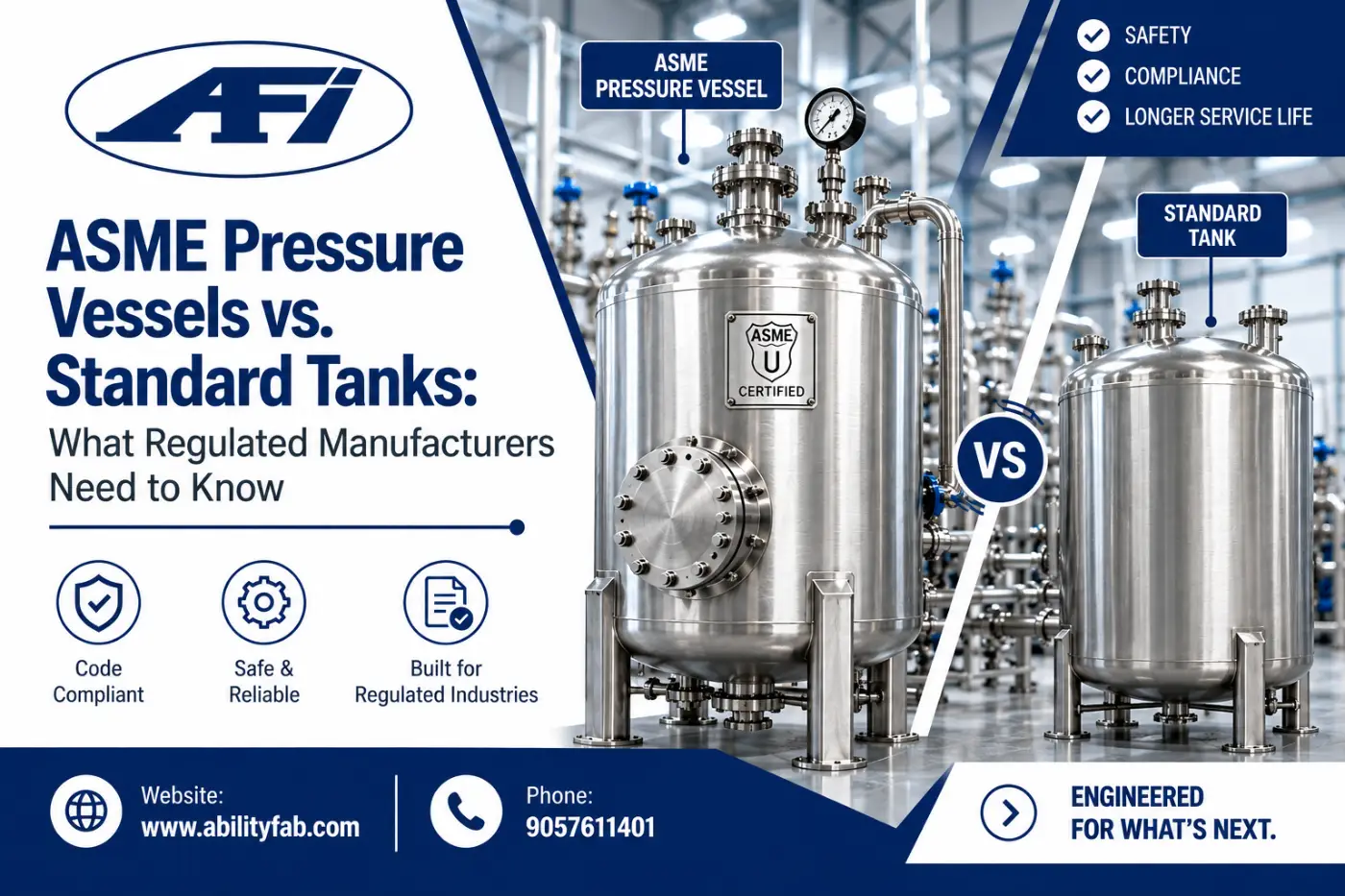
A pharmaceutical plant in Ontario recently hit an expensive roadblock during a routine facility audit. Their engineering team had installed a new stainless tank for a process line, assuming it met general shop standards. The audit finding? The system occasionally operated at 18 psig, but the tank was only rated for atmospheric storage. That single oversight meant weeks of lost production, regulatory headaches, and an emergency order to build and register a code-compliant vessel from scratch.
This confusion between standard storage tanks and ASME pressure vessels happens far more often than it should. Choosing between them isn’t just a minor design detail – it dictates operator safety, regulatory compliance, and your capital budget. This breakdown explains the mechanical differences, clarifies when code compliance is mandatory, and helps you select the right equipment for your facility.
What Makes a Vessel "ASME Certified"?
The American Society of Mechanical Engineers (ASME) created the Boiler and Pressure Vessel Code (BPVC) to establish strict safety and construction standards for sealed containment equipment. Today, the BPVC is the mandatory benchmark for industrial pressure equipment across North America.
ASME Section VIII Basics
Section VIII of the BPVC sets the rules for designing and executing pressure vessel fabrication for unfired containers. It specifies exact formulas for shell thickness, dish head geometries, nozzle reinforcement, welding credentials, and non-destructive testing.
The code applies to any vessel operating at an internal or external pressure exceeding 15 psig (1 bar gauge):
- Division 1: The standard baseline for general industrial equipment. It uses a conservative safety factor of 3.5 based on the material’s ultimate tensile strength.
- Division 2: Allows higher stress limits (with safety factors between 2.4 and 3.0), but requires advanced stress analysis and finite element modeling. It is typically used for heavy-wall or expensive alloy builds where reducing weight saves material cost.
- Division 3: Governs extreme high-pressure applications operating above 10,000 psig.
Stamping & Documentation Requirements
An ASME-certified vessel carries a permanent code nameplate stamped with an official symbol – most commonly a “U” stamp for Section VIII, Division 1 builds, or a “UM” stamp for smaller vessels.
In Canada, compliance goes a step further. Vessels must also carry a Canadian Registration Number (CRN) issued by provincial safety authorities, like Ontario’s Technical Standards and Safety Authority (TSSA). A valid CRN proves that design calculations were reviewed and legally approved for installation in that province. Every finished vessel ships with a complete data package: Manufacturer’s Data Reports (Form U-1), material test reports (MTRs), weld maps, and NDT inspection records.
Pressure Vessel vs. Standard Tank: Key Differences
The difference between a standard atmospheric tank and a pressure vessel comes down to wall thickness, head design, joint construction, and legal certification.
Design Pressure & Safety Margins
Standard atmospheric tanks store liquids at ambient pressure. They are built to liquid storage standards like API 650, using lighter gauge sheet metal and lap-welded joints.
Conversely, stainless steel pressure vessels are engineered to withstand continuous internal pressure, full vacuum conditions, and heavy thermal cycling. Using ASME Section VIII Division 1 formulas, engineers calculate minimum shell and head thicknesses while accounting for corrosion allowances, joint efficiency, and material yield strength. This ensures the vessel handles working pressures up to 3,000 psi without structural fatigue over decades of service.
When Code Compliance Is Mandatory
If your operating fluid or blanket gas pressure exceeds 15 psig, building to ASME code is a legal requirement, not an optional preference. Under Canadian provincial safety regulations (such as CSA Standard B51), running an unregistered, non-code vessel above 15 psig exposes your operation to severe consequences:
- Immediate equipment lockout orders from safety inspectors.
- Heavy regulatory fines and uninsurable liability risks.
- Unplanned downtime while sourcing an emergency replacement vessel.
Industries That Require ASME Vessels
Regulated processing facilities rely on pressure-rated equipment to maintain cleanroom environments, execute high-temperature reactions, and protect plant personnel.
Pharmaceutical & Food Processing Use Cases
In hygienic manufacturing, pharmaceutical pressure vessels and food-grade reactors handle critical processing steps:
- Sterilization (SIP & Autoclaves): Steam-in-place cycles pressurize tanks with clean steam at temperatures above 121°C to sterilize internal surfaces between production batches.
- Pressurized Transfer & Blanketing: Moving shear-sensitive liquids between vessels using pressurized nitrogen gas (above 15 psig) requires a pressure-rated vessel.
- Chemical Synthesis: Active pharmaceutical ingredient (API) processing and food additive reactions frequently take place inside high-temperature, pressurized jacketed reactors.
While a simple storage tank holding ambient purified water only needs atmospheric construction, any vessel tied into a steam line or pressurized gas system must be built as an ASME certified tank.
Choosing a Certified Fabricator
Not every metal shop has the quality control systems or technical credentials needed to build code vessels. ASME certification demands rigorous quality audits, certified welding procedures (WPS), qualified welders (WPQ), and independent third-party inspection by an Authorized Inspector (AI).
When selecting a fabrication partner, verify these essentials:
- Active ASME & Provincial Accreditation: Confirm the fabricator holds a valid ASME “U” stamp and provincial registration (such as TSSA authorization in Ontario).
- In-House Engineering: Look for an engineering team that handles ASME design calculations, 3D modeling, and CRN registration paperwork in-house.
- Full Material Traceability: Every plate, pipe, flange, and welding wire heat number must trace directly back to mill test reports.
- Sanitary Design Expertise: For pharma or food applications, your fabricator must understand sanitary interior finishes (down to 15 Ra or electropolished), clean-in-place (CIP) spray ball coverage, and radiused internal corners on top of structural code rules.
Ability Fabricators combines decades of shop-floor experience with full ASME and TSSA certifications to deliver pressure equipment that passes provincial audits on the first inspection. To review our capabilities, learn more about ourcustom ASME pressure vessel fabrication services.
Conclusion
Deciding between a standard storage tank and an ASME pressure vessel comes down to operating conditions. If your process operates above 15 psig – or uses pressurized steam or gas for fluid transfers – an ASME-certified vessel is mandatory. Specifying proper code equipment up front protects your workers, prevents costly audit shutdowns, and ensures safe operation for the long haul.
Partnering with an accredited fabricator ensures your equipment arrives on-site fully documented, stamped, and ready for service. Contact Ability Fabricators today to review your project specifications or request a detailed engineering quote.
Faqs
Division 1 rules apply to pressure vessels operating above 15 psig and are generally used for design pressures up to 3,000 psig. Above 3,000 psig, fabricators transition to Division 2 or Division 3 guidelines.
No. ASME certification requires step-by-step material traceability, approved weld procedures, and third-party inspections during primary fabrication. A non-code tank cannot be retroactively stamped after construction.
A “U” stamp covers standard pressure vessels built under Section VIII Division 1 rules. A “UM” stamp applies to smaller miniature vessels (typically under 5 cubic feet of volume depending on pressure) that follow specialized rules but still require National Board tracking.
You should receive a complete binder containing the Manufacturer’s Data Report (Form U-1 or U-1A), approved design drawings, CRN registration certificate, material test reports (MTRs), liquid penetrant or X-ray NDT reports, and hydro-test certificates.