Ask any plant manager what keeps them up at night, and “unplanned shutdown” sits right at the top of the list. In a chemical facility, those shutdowns rarely come out of nowhere; they usually start small. A micro-crack along a weld, subtle pitting inside a reactor vessel, or a pinhole leak in a transfer line can quickly degrade high-value chemical processing equipment. Before long, a minor material breakdown turns into lost product, safety risks, and an unexpected audit.
When your daily operations involve aggressive compounds, selecting and building your process hardware isn’t just a line item in the capital budget. It’s your primary defense against costly operational risk.
What Makes an Environment "Aggressive"?
Not all process streams affect metal the same way. A vessel handling a mild organic wash might run smoothly for decades, while the exact same vessel carrying hot process brine can fail in under a year. Identifying the precise degradation mechanisms at play in your facility is the first step toward building hardware that actually lasts.
Common Corrosive Agents in Chemical Processing
Chemical processing systems face several distinct chemical mechanisms that systematically attack structural metals:
- Chlorides: Show up in hydrochloric acid, process brine, and plenty of chemical feedstocks. Once temperatures start climbing, they turn into localized pitting, crevice attack, and chloride stress corrosion cracking (CSCC).
- Mineral Acids: Sulfuric, phosphoric, and nitric acids don’t all behave the same way. Depending on concentration, fluid velocity, and heat, they cause either uniform surface dissolution or fast wall thinning.
- Caustic Solutions: A slower kind of threat. Sodium hydroxide and other highly alkaline media cause embrittlement and micro-cracking that build up gradually in susceptible metals.
- Oxidizing and Reducing Agents: Mix oxidizing and reducing agents in the same stream, and things get unstable fast. That combination is usually what pushes a facility toward multi-element nickel alloys in the first place.
- Elevated Temperatures: Heat doesn’t corrode metal on its own, but it speeds up everything else. Elevated operating temperatures push base metals past their rated limits faster than most people expect.
Material Selection for Corrosion Resistance
Choosing the right alloy means looking at the whole picture: process chemistry, fluid concentration, working pressures, and thermal cycles. Matching your material specs to the reality of your fluid environment protects your capital investment and keeps your lines running.
316L vs. Specialty Alloys
316L stainless steel is the default for a reason. Its 2% to 3% molybdenum content gives it a real edge over standard 304 in pitting and crevice resistance, which is why it’s the go-to stainless steel for chemical industry applications running mild chloride levels or moderate organic acids.
Push the process harder, though, and 316L runs out of headroom. That’s when facilities move to higher-performance corrosion-resistant stainless steel grades or nickel-based alloys instead:
- Hastelloy C-276 and C-22: High-nickel chromium-molybdenum alloys built for severe pitting, stress corrosion cracking, and aggressive oxidizing or reducing acid blends. These are the standard choice for mixed-acid media and hot chloride exposure.
- Duplex Stainless Steels (e.g., Duplex 2205): Roughly double the yield strength of standard austenitic grades and resist CSCC exceptionally well. That makes them a strong fit for sour gas processing, marine exposure, and high-pressure utility loops.
- Alloy 20: Formulated specifically for sulfuric acid service. This nickel-iron-chromium alloy holds up against hot, aggressive acid concentrations that would eat through lesser materials.
- 904L Super Austenitic: Adds extra nickel, molybdenum, and copper to the mix, giving it an edge against sulfuric and phosphoric acid where standard 300-series alloys start to fail.
- Titanium and Zirconium: Reserved for the harshest environments (near-universal resistance to highly oxidizing acids and wet chlorine) for applications where the cost premium is worth it.
Surface Finishing & Passivation
Picking the right alloy is only half the equation. What happens to that metal during fabrication, welding, and finishing has just as much bearing on how long a vessel actually lasts in service.
- Passivation: Uses a nitric or citric acid wash to strip away the free iron left behind by cutting tools and forming equipment. Once that surface iron is gone, the alloy can form its natural chromium-oxide film, which is the layer actually doing the protecting.
- Mechanical Polishing & Electropolishing: Both deal with surface roughness, just at different depths. Mechanical polishing knocks down the Ra value enough to eliminate the microscopic pockets where corrosive media tend to settle. Electropolishing takes it further, chemically stripping away surface peaks for an ultra-smooth finish that’s easier to clean and holds up better overall.
- Bead Blasting: Mostly for external, non-contact surfaces, removing heat tint and mill scale to leave a uniform matte finish, usually somewhere in the 60 to 125 Ra microinch range.
Equipment Types Built for Chemical Processing
Once the material spec is locked in, the next question is what actually gets built with it. A handful of equipment categories show up again and again on a chemical plant floor, and each one has to survive the same corrosive conditions as the process itself.
Tanks, Enclosures, and Panels
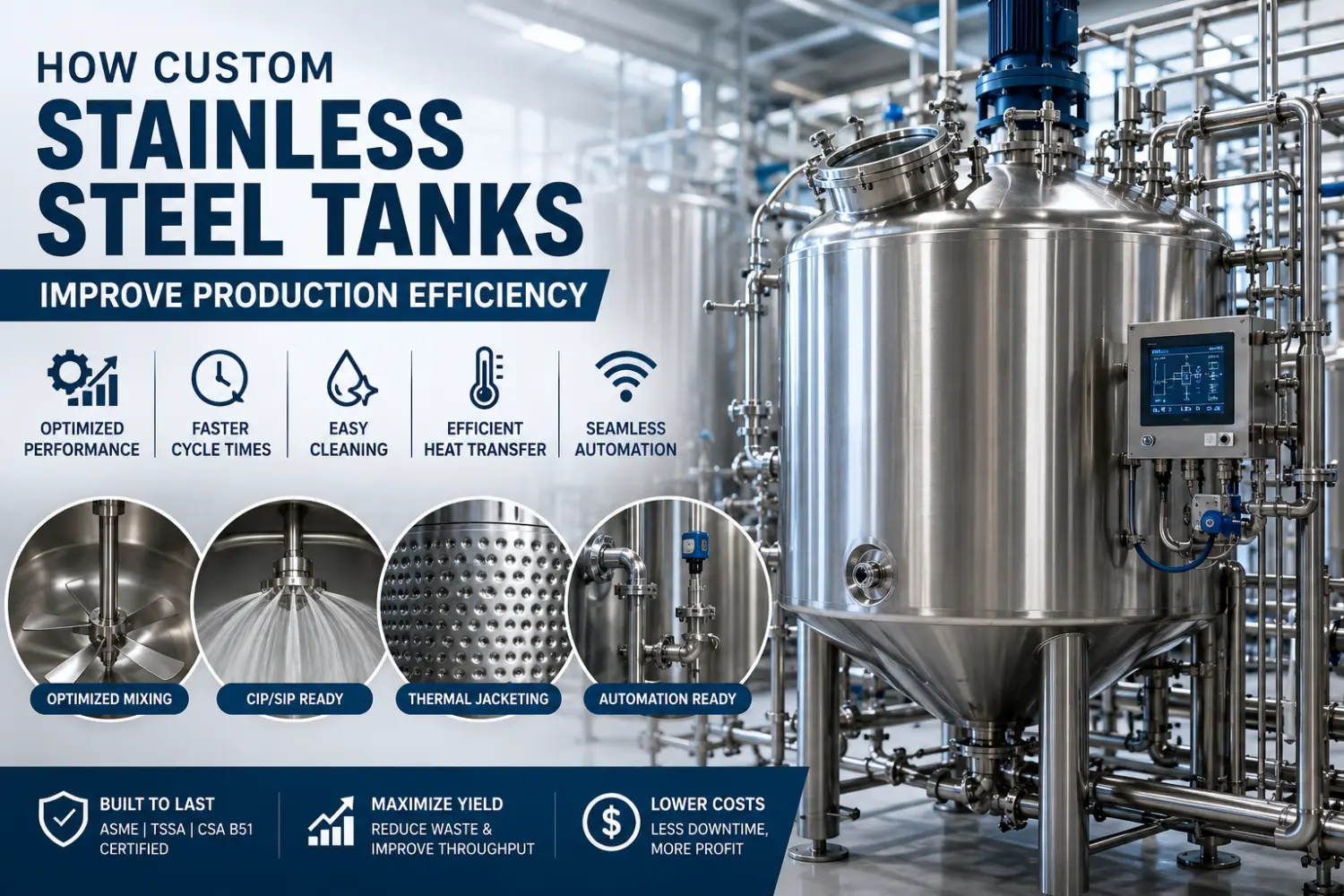
- Stainless Steel Tanks and Vessels: The backbone of the whole operation, everything from simple atmospheric storage tanks up to ASME Section VIII-rated pressure vessels. Depending on the process, they’re built in 304, 316L, or specialty alloys, and can carry heating or cooling jackets, internal baffles, high-shear agitation, and nozzle layouts sized to the piping around them.
- Chemical-Resistant Enclosures and Panels: Easy to overlook, but just as important. Electrical and control hardware doesn’t tolerate corrosive atmospheres any better than a vessel does, so it needs its own protection: NEMA 4 and CSA-rated stainless enclosures for general isolation, stepping up to NEMA 4X anywhere the equipment sees regular chemical washdown.
- Catwalks and Walkovers: Anywhere workers need to cross over open vessels or move through a processing bay, that platform has to be corrosion-resistant and slip-resistant at the same time, not one or the other.
To evaluate custom units engineered to your process conditions, explore our chemical processing equipment fabrication options.
Working with a Fabricator on Chemical-Grade Equipment
None of this holds up without the right shop behind it. Chemical-grade equipment takes real metallurgical know-how, certified welding procedures, and quality checks that don’t leave room for guesswork, which means the fabricator matters almost as much as the alloy itself.
Ability Fabricators brings over 150 years of combined experience building custom stainless steel equipment for chemical, pharmaceutical, and food processing operations across North America. In practice, that looks like:
- Metallurgical and Material Selection Guidance: Our engineers help weigh material cost against expected service life, so the alloy you end up with actually fits your fluid chemistry, not just your budget.
- Certified Code Welding: Welders qualified to ASME Section VIII and project-specific TIG procedures. Inert gas back-purging, controlled filler metal selection, and post-weld passivation keep weld seams from sensitizing and losing corrosion resistance.
- Comprehensive Quality Assurance: Heat-number material traceability, Positive Material Identification (PMI) testing, and full Material Test Reports (MTRs), all confirming chemical composition and physical properties before anything ships.
- Complete Audit Documentation: Weld logs, non-destructive testing (NDT) reports, and surface finish certifications, packaged for internal review and third-party regulatory compliance.
Conclusion
There’s no real margin for error once aggressive chemicals are in the mix. Keeping a plant safe and running comes down to a few things: matching alloys to the actual process chemistry, designing out the features that trap corrosive media, and working with a fabricator that doesn’t cut corners on precision.
Get that right, and your chemical processing equipment stops being something you worry about. Maintenance drops. Failures stop being a surprise. Uptime becomes something you can plan around instead of hope for.
Investing in specialized chemical equipment fabrication protects your operations long-term. Contact Ability Fabricators today to review your mechanical specifications or request an engineering proposal for your facility.
Faqs
Selection depends strictly on process chemistry, temperature, and fluid concentration. Grade 316L is the baseline standard for general chemical service with mild chloride exposure. For severe service involving hot acids, mixed chemical streams, or high chloride concentrations, specialty alloys such as Hastelloy C-276, Duplex 2205, or Alloy 20 are required.
Passivation uses a controlled acid formulation to remove tramp iron particulates deposited on the metal surface during cutting, forming, and welding. Stripping free iron allows the chromium within the alloy to react naturally with atmospheric oxygen, creating a continuous chromium-oxide passive film that protects the base metal from corrosion.
Grade 316 contains 2% to 3% molybdenum, whereas Grade 304 contains none. The addition of molybdenum substantially improves resistance to localized pitting, crevice attack, and chloride-induced corrosion, making 316L the preferred choice for aggressive chemical applications.
In limited scenarios, applying high-alloy weld overlays or specialized protective coatings can extend service life. However, field modifications are complex and often offer temporary protection. For high-pressure, high-temperature, or hazardous chemical operations, complete unit replacement using high-performance alloy fabrication provides the most reliable long-term solution.