In the pharmaceutical manufacturing sector, few scenarios are as costly as a failed blend uniformity test on the eve of a batch release. When an Out-of-Specification (OOS) result triggers a review of the original equipment procurement, the consequences extend far beyond a delayed shipment. It often necessitates a formal GMP non-compliance investigation, expensive reprocessing of materials, and the potential loss of high-value APIs that can cost hundreds of dollars per gram.
This challenge is more prevalent than industry benchmarks might suggest. The frustration often stems from the fact that both the V-Blender and the Double Cone Blender appear to be equally viable solutions. Both are gravity-driven tumble blenders, constructed from pharmaceutical-grade stainless steel, and utilized extensively across North American manufacturing facilities for powder blending equipment projects.
At Ability Fabricators, we have spent over 25 years engineering and manufacturing custom pharmaceutical powder blending equipment for clients across Canada and the United States. We understand that the decision between these two technologies is rarely about which machine is “better” in a general sense, but rather which is most compatible with your specific material characteristics, facility constraints, and validation requirements.
How Each Blender Works
The V-Blender: Splitting, Recombining, Repeat
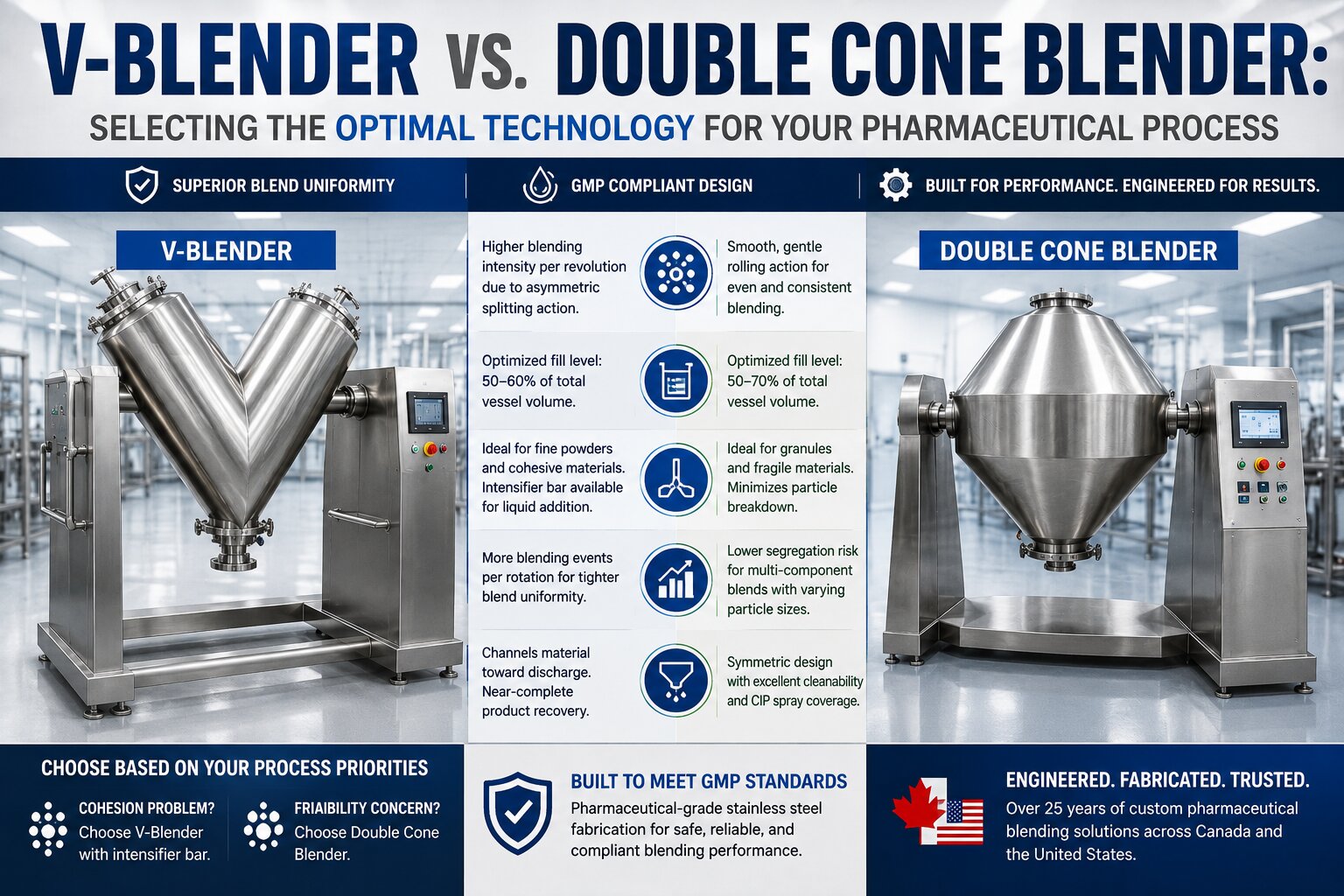
The stainless steel V-blender rotates on a horizontal axis. As it turns, your powder blend splits, half traveling into one arm of the V and the 2nd half into the other, then falls back together at the bottom. That cycle repeats with every revolution, generating more blending events per rotation than most other tumble blender designs on the market.
Optimal fill sits at 50–60% of total vessel volume. If your material is cohesive or you need liquid addition capability, an optional intensifier bar handles that without requiring you to step up to a higher-shear blending technology entirely. It’s a workhorse design backed by decades of published pharmaceutical scale-up data, which carries real weight when your regulatory submission needs solid process justification.
The Double Cone Blender: Smooth, Even, and Underrated
The double cone blender pharmaceutical design approaches the problem differently. A symmetric vessel rotates end-over-end on a central axis, and material rolls gently from cone to cone in one continuous, even motion. No asymmetric tumbling. Just a smooth, predictable cycle that handles your blend and your granules with noticeably more care.
Fill levels can go slightly higher, typically 50–70% of total vessel volume. Intensifier bar and liquid addition ports are available here too, though the Double Cone’s inherently gentler baseline motion means you’ll need them less often. The symmetric interior is also something your cleaning validation team quietly appreciates when it’s time to document CIP spray coverage and sign off on the protocol.
Where the Differences Matter
In our experience, this is where the decision really gets made. Or should be.
If you’re blending fine API powders, the kind that generally carry electrostatic charge, bridge across vessel surfaces, or resist uniform distribution through conventional tumbling, the V-Blender with an intensifier bar is almost always the right answer. The asymmetric splitting action creates more blending energy per revolution, and the intensifier bar breaks up agglomerates and drives dispersion in a way the smoother Double Cone motion simply can’t replicate at baseline.
If you’ve already completed granulation and you’re blending pre-formed granules ahead of compression, where preserving those granules intact through the blending cycle is the entire point of the exercise, the Double Cone Blender is the gentler, safer choice. The rolling motion is less aggressive. Particle breakdown is minimized. What goes into the vessel looks much closer to what comes out, which is exactly what tablet pre-blend processes need.
The shortcut most experienced process engineers use and trust:
Cohesion problem → V-Blender with intensifier bar.
Friability concern → Double Cone Blender.
Blend Uniformity and Segregation Risk
The V-Blender’s asymmetric splitting action tends to produce tighter blend uniformity for fine powders and complex multi-component API blends, particularly when you’re working against demanding Relative Standard Deviation (RSD) targets in blend uniformity testing. The additional blending events per revolution give it an edge with materials that genuinely resist mixing.
The Double Cone Blender performs excellently for denser, more free-flowing materials and actually has a meaningful advantage when it comes to segregation risk in multi-component blends with varying particle sizes or densities. The symmetric rolling motion keeps mixed components together in a way that the V-Blender’s splitting action occasionally doesn’t, especially during discharge.
And on that note! Regardless of which design you choose, always sample for blend uniformity at the discharge point. Post-blend segregation is a real risk in both designs when particle populations have significant size or density variation. No blender compensates for a formulation that’s fundamentally prone to segregation. It gives you the best achievable outcome for the blend you put into it.
GMP Compliance: The Details Your Auditor Will Look For
Vessel Geometry, Welds, and Dead Zones
The stainless steel V-blender naturally channels material toward the discharge outlet as the vessel rotates. Dead zones are minimal, product recovery is near-complete, and the geometry practically assists its own cleanout. It’s one of the reasons this design has such a long, well-documented track record in regulated pharmaceutical powder blender environments.
The Double Cone’s symmetric taper also drives clean, complete discharge. Where fabricators need to pay close attention is the central transition zone where the two cones meet. Poorly executed welds in that area create crevices, and crevices are where cleaning validation fails, where residual product harbors, and where auditors start writing observations during facility reviews.
This isn’t a design flaw. It’s a fabrication discipline issue. At Ability Fabricators, both designs are built with fully-penetrated, crevice-free welds and internal surfaces polished to Ra ≤ 0.8 µm as standard. For direct API contact surfaces, we go to Ra 0.5 µm or better. Electropolishing is available on both designs and enhances the passive oxide layer in a way that makes Health Canada and FDA surface validation considerably more straightforward.
CIP Compatibility and Cleaning Validation
The V-Blender’s split-arm geometry creates more total internal surface area to cover during cleaning. With properly designed CIP spray nozzle placement, complete coverage is fully achievable and ready for validation. It just requires deliberate engineering upfront rather than as an afterthought.
The Double Cone’s simpler symmetric interior is marginally easier to validate for CIP spray coverage. In multi-product facilities where cleaning validation documentation is already a significant and ongoing burden, that simplicity has real operational value. Both designs are fully CIP-compatible when the system is specified correctly at the time of order.
Facility Layout: Sometimes the Building Picks the Blender
Process engineers don’t always get to choose their blenders freely. Sometimes the facility makes the call for them, and it’s better to know that going in.
The V-Blender sweeps a wide horizontal arc through its rotation cycle. In height-constrained cleanrooms or mezzanine-loaded facilities, which are common across older pharmaceutical manufacturing sites in Toronto and across southern Ontario, the V-Blender is typically the more forgiving option for installation.
The Double Cone Blender rotates end-over-end and requires significant vertical clearance above and below the vessel. That requirement catches facilities off guard more often than it should, particularly in retrofit or expansion scenarios where ceiling height wasn’t part of the original conversation. If headroom is available and the floor footprint is the tighter constraint, the Double Cone often has the edge.
On capacity: V-Blenders run from 2 qt bench-top lab configurations up to 125 cu ft for full production scale. Double Cone Blenders cover 2 qt through 100 cu ft. There’s enough overlap between both ranges that vessel size alone rarely resolves the decision.
Side-by-Side Comparison
|
Factor |
V-Blender |
Double Cone Blender |
|
Blending Mechanism |
Asymmetric split/recombine tumbling |
Symmetric end-over-end tumbling |
|
Best Material Type |
Fine powders, APIs, cohesive blends |
Free-flowing granules, mixed densities |
|
Fragile Granule Handling |
Moderate (intensifier bar adds shear) |
Excellent — lowest shear of both |
|
Intensifier Bar Option |
Yes |
Yes |
|
Liquid Addition |
Yes |
Yes |
|
CIP Compatible |
Yes |
Yes |
|
GMP/FDA Compliant |
Yes |
Yes |
|
Capacity Range |
2 qt – 125 cu ft |
2 qt – 100 cu ft |
|
Footprint |
Wider horizontal sweep |
Taller vertical clearance needed |
|
Scale-Up Data |
Extensive pharma literature |
Good, less published data |
|
Discharge Efficiency |
Excellent |
Excellent |
|
Cleanability |
Good (CIP recommended) |
Slightly simpler geometry |
|
Relative Cost |
Comparable |
Comparable |
|
Best Pharma Application |
API blending, solid dosage forms |
Granule blending, tablet pre-blends |
Which One Should You Choose?
Go with the V-Blender when your process involves fine API powders or cohesive materials that need an intensifier bar to achieve adequate dispersion, when liquid addition for wet granulation prep is required, when published scale-up data needs to support your regulatory submission, or when ceiling height is the tighter facility constraint.
Go with the Double Cone Blender when granule integrity through the blending cycle is non-negotiable. Your multi-component blend has a density variation that benefits from symmetric flow, changeover speed in a multi-product facility is a real operational priority, or floor footprint matters more than vertical clearance.
When either genuinely works, and for straightforward excipient blending with similar particle characteristics, both often do; let facility layout, existing equipment compatibility, cleaning validation protocol, and long-term production scale targets make the final call.
How Ability Fabricators Builds Both
Both the V-Blender and Double Cone Blender are engineered and fabricated entirely in-house at our Concord, Ontario, facility. Every project begins with 3D modeling and design validation before fabrication starts. CWB-certified welding, ASME, TSSA, CSA B51, and full GMP Standard Compliance across every build.
If you’re still working through the decision, bring us your process parameters, your facility constraints, and your validation requirements.
We’ve been navigating this conversation with pharmaceutical engineering and procurement teams for over 25 years, and we’ll help you land on the right answer before it turns into an expensive one.
Frequently Asked Questions
The V-Blender splits and recombines your material with every revolution, creating more blending events, better for fine powders and cohesive APIs. The Double Cone Blender rolls material end-over-end in one smooth, continuous motion, gentler and noticeably kinder to fragile granules. Same equipment category, different mechanical behavior, different best-fit applications.
For most pharmaceutical API blending applications, fine powders, cohesive materials, and complex multi-component blends, the V-Blender wins. The asymmetric splitting action drives better dispersion, and decades of published scale-up data make regulatory justification straightforward. If your API blend involves pre-formed granules where particle integrity matters, the Double Cone Blender becomes the stronger choice.
Both are fully appropriate for GMP-certified pharmaceutical environments when properly fabricated. The equipment doesn’t determine compliance; the weld quality, surface finish, and documentation behind the build do. At Ability Fabricators, every blender ships with full MTRs, surface finish certification, and IQ/OQ/PQ validation support, built to survive a Health Canada or FDA audit, not just to function on the floor.
For the V-blender, stay between 50% and 60% of total vessel volume, enough room for the material to split and recombine effectively. The Double Cone Blender is slightly more forgiving at 50–70% due to its symmetric motion. Either way, treat these as starting points and confirm your optimal fill level through blend uniformity validation, not assumption.
Both do, but CIP needs to be engineered in from the start, not retrofitted later. The Double Cone’s simpler symmetric interior is marginally easier to validate for spray coverage. The V-Blender requires more deliberate nozzle placement given its split-arm geometry. Specify CIP at the time of order, and it’s a non-issue; try to add it afterward, and you’ll spend months closing gaps in your cleaning validation protocol.
That’s exactly how we work! Every blender that leaves our Concord, Ontario, facility is built to your specific process, not pulled from a standard catalog. Vessel capacity, valve type, surface finish, material grade, intensifier bar, CIP integration, fixed or mobile base — all engineered to your requirements from day one. If you have a process in mind and aren’t sure where to start, that’s what our engineering team is here for.
316L stainless steel is the recommended grade for most pharmaceutical blender applications. Its molybdenum content improves corrosion resistance against cleaning agents and process solvents, and the low-carbon designation protects weld integrity. 304 stainless steel works well for excipient and nutraceutical applications where chemical exposure is less demanding. When in doubt, specify 316L. Downgrading that decision later is a much harder conversation than getting it right from the start.