There’s a conversation that happens a lot in manufacturing facilities, usually during a production review that’s running long. A plant engineer realizes that the equipment they inherited, a row of fixed stainless steel tanks, is quietly eating three hours every time the team switches formulations. Full manual emptying. Extended cleaning cycles. A growing backlog on the next batch. And somewhere in the original procurement decision, nobody seriously asked whether an IBC bin blender system would have served them better.
That’s the conversation worth having before you commit to anything. Choosing between IBC bin blenders and stainless steel tanks isn’t just about picking a piece of equipment. It’s a decision about how your entire production line will operate, day after day, for years. Get it right, and the line runs cleanly. Get it wrong, and you spend the next decade building workarounds into your daily operations. This guide is for production managers and plant engineers who are in the middle of that choice or about to be.
What IBC bin blenders actually do
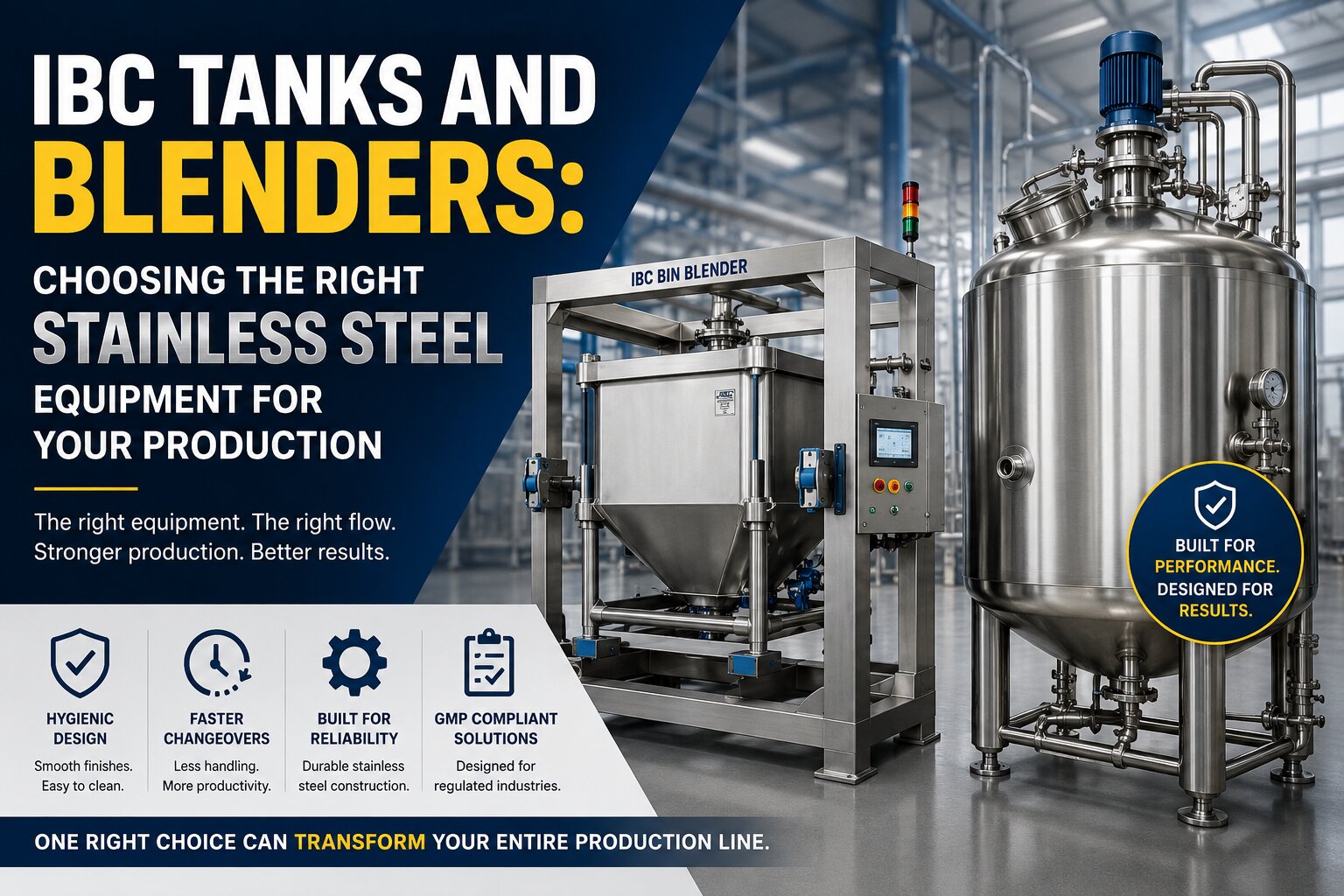
The bin, the intermediate bulk container, is the blending vessel. You load your dry ingredients into it, clamp the bin onto the blending frame, and the controlled rotation of the frame tumbles the contents until they’re uniformly mixed inside the same container. When blending is done, that bin moves downstream directly. It docks with your tablet press, your filling line, and your packaging station. You never transfer the product into a second vessel. Properly maintained IBC tanks can support long-term industrial use while reducing material handling costs.
That single design choice changes the economics of multi-product manufacturing in a way that’s easy to underestimate until you’ve lived through a high-changeover operation.
How contained bin blending works in practice
Ability Fabricators’ IBC bin blenders systems are built around a pneumatic clamping system that locks the bin securely to the frame, an electric drive with variable speed control, PLC-based automation for consistent cycle management, and integrated safety gates. The bins themselves, available in SS 304 or SS 316L, are fabricated with smooth internal surfaces and crevice-free welds, because hygiene between batches isn’t optional in regulated environments.
The containment aspect matters more than most people initially appreciate. The product never leaves the closed bin during blending. That eliminates most of the dust generation, reduces cross-contamination risk, and limits operator exposure, all things that show up on GMP audit reports when they’re not managed well.
Where IBC blenders genuinely earn their place
If your facility runs five, ten, or twenty different formulations in a given week, each requiring a full cleaning cycle between runs, the math on manual transfer-based blending gets painful fast. These commercial blenders simplify the sequence: one bin per formulation, load it once, blend it, move it forward. The frame stays fixed; only the bin changes. Changeover times drop considerably.
For facilities that span both lab-scale development and full production, AFI’s systems scale to match from bench-top units suitable for R&D batches through to industrial production configurations. The full range is covered on the stainless steel blenders and mixers page.
Stainless steel tanks - the other half of the picture
When the product flows, the tank takes over. Powders get a lot of attention, but liquids, slurries, emulsions, and solutions make up a substantial share of what food, beverage, pharmaceutical, and chemical manufacturers actually produce. For those applications, a custom stainless steel tank is the ideal tool required. Designed to hold, mix, heat, cool, or process fluid and semi-fluid materials, these vessels do heavy lifting across industries. But the word tank covers far more ground than most people expect, and that’s precisely where specification mistakes tend to creep in.
Custom stainless steel tanks are designed for holding, mixing, heating, cooling, or processing liquid and semi-liquid materials. But the tank covers a wider range of design variation than most people realize, and that’s where specification errors creep in. Custom stainless steel fabrication services in Toronto help businesses create tailored tanks, conveyors, workstations, and processing equipment.
Storage tanks versus process tanks
A storage tank holds material safely and hygienically until it’s needed elsewhere. The main design concerns are drainage, surface finish, vent filtering, and CIP compatibility. Relatively straightforward to spec correctly.
A process tank is a different animal. It may be jacketed for temperature control, heating or cooling the contents as part of the process. It likely needs mechanical agitation to keep the product in suspension or drive a reaction. It may require ports at specific positions, particular level sensor arrangements, or outlet geometry designed to prevent product buildup at the base. The design has to follow the process logic, not just the storage requirement.
This distinction matters enormously when you’re specifying equipment. A storage tank ordered for a process application or the reverse creates operational problems that are entirely avoidable if the design conversation happens early.
When you need a tank instead of a blender
This decision will entirely depend on the stage of production your product is going through. Tanks are preferred for storing liquids, mixing fluid materials, and preserving ingredients at a controlled temperature. Products like milk, sauce, syrup, and chemicals are a few examples of this kind. Use IBC blenders when the product is dry or in granular form. It reduces contamination and helps to transfer the powders into the next production stage. Items like protein powder. Spices and flour mixes are commonly processed for consistent blending.
Many operations need both. A nutraceutical facility might use IBC blenders to combine dry ingredients, then transfer the blended powder into a stainless steel mixing tank, where it’s combined with a liquid carrier before filling. Ability Fabricators’ IBC containers and tanks are designed with integrated production lines in mind, not as standalone pieces of equipment that happen to coexist.
For operations that need bulk product storage or movement between process stages, stainless steel containers provide a complementary solution alongside tanks.
A practical framework for making the call
Production decisions involve too many variables for gut feel alone. These questions usually clarify the direction fairly quickly.
What is the physical state of your product at the point of processing dry powder, granule, liquid, or slurry? How many formulations do you run per week, and how long does changeover currently take you? Does your process require temperature control, CIP cleaning, or containment to protect operators? What are your downstream connections? Does the product need to be transferred between vessels, or can it stay in the same container throughout?
Dry powder operations
Pharmaceutical tablet manufacturing, nutraceutical capsule filling, spice blending, specialty chemical powder processing- these share a common challenge. You’re handling fine dry materials that need uniform blending, minimal product exposure, and fast turnaround. The IBC bin blender addresses all three simultaneously. The bin is the vessel, transfer is eliminated, and the same container continues to the next process step.
Liquid and semi-liquid operations
Beverage production, dairy processing, liquid pharmaceutical manufacturing, and cosmetic emulsification require vessels that can handle fluids under controlled conditions, with appropriate agitation and temperature management. A properly specified stainless steel tank handles this. An IBC blender is not designed for liquid applications and shouldn’t be used as one.
Mixed operations
Sophisticated production environments often run both. It’s worth involving engineering and process teams early to map the full production flow before committing to either piece of equipment independently. Getting one piece right while the other remains a bottleneck doesn’t solve the problem.
SS 304 vs. SS 316L : getting the material selection right
This question comes up on nearly every project. Both grades are common in industrial and regulated environments, but they’re not interchangeable, and the wrong choice shows up in service life and compliance audits down the road.
When 304 is appropriate
Grade 304 is well-suited for structural components, frames, platforms, guards, and enclosures that don’t contact your product directly. It’s also acceptable for some food applications where the product doesn’t involve significant chloride or acid exposure. It’s durable and cost-effective in the right contexts.
Why does food-contact and pharmaceutical equipment default to 316L
The molybdenum content in 316L stainless steel meaningfully improves resistance to chloride pitting, the kind of corrosion that develops on tank interiors after repeated exposure to cleaning agents and food or pharmaceutical materials. Once pitting establishes itself, it creates microscopic surface irregularities that harbour bacteria and resist aggressive cleaning. 316L resists pitting under these conditions far better, and it holds its surface integrity over a longer service life.
Both Ability Fabricators’ pharmaceutical equipment and food and beverage equipment lines default to 316L for all product-contact surfaces. Material Test Reports are available on request for full traceability on the grade used in your build.
What to look for in a fabricator
Equipment is only as good as the people who built it, and the documentation that proves how it was built.
Certifications that should matter to you
Ability Fabricators operates at the highest level of certified manufacturing. CWB-certified welding meets documented, tested standards. ASME certification covers pressure-rated vessels. TSSA compliance satisfies Ontario’s regulatory requirements for pressure equipment. GMP practices ensure surface finish, traceability, and documentation meet regulated industry standards, all supported by complete audit-ready packages.
In-house engineering versus sub-contracted fabrication
There’s a real operational difference between a supplier that designs and builds under one roof versus one that sends drawings to a third-party shop. When engineering and fabrication are separated, accountability follows. Changes that come up mid-build, and they almost always do, take longer to resolve because the communication chain is longer and the people who made the original design decisions aren’t the ones holding the welding torch.
At Ability Fabricators’, the engineering team and the fabrication team work from the same facility in Concord, Ontario. The people who reviewed your process requirements are accessible when a fabrication question comes up. Quality control runs through every stage, from material receipt, fabrication, surface finishing, and pre-shipment inspection.
Ability Fabricators' approach - one facility, consistent standards
Since 1999, Ability Fabricators has been building custom stainless steel process equipment for pharmaceutical, food, nutraceutical, and chemical manufacturers across North America, all from a single facility in Concord. Every project goes through the same quality system. Every team member works to the same standards.
For production managers and plant engineers in Ontario and the GTA, it also means site visits are entirely practical. We’ve always encouraged clients to come in during the fabrication process. Seeing your equipment take shape before it arrives on your floor tends to catch issues early and build confidence in the final product. Full fabrication capabilities are detailed here.
Making the right decision - and building it properly
The choice between IBC bin blenders and stainless steel tanks ultimately comes down to your product, your process, and the way your production line is actually structured. Neither is universally better. They solve different problems, and in many operations, they’re most effective working together.
What doesn’t change across either decision is the need for correct material selection, thoughtful design from the start, and fabrication quality that holds up under the conditions your facility actually operates in. That’s the work Ability Fabricators’ has been doing for over 25 years.
If you’re working through a capital equipment decision, or if your current setup isn’t performing the way it should, we’re happy to talk through it. Request a quote or reach out directly. We’re used to working through complicated production challenges, and there’s no commitment required to start that conversation.
Faqs
An IBC bin blender mixes dry powders and granules inside a removable bin, while a stainless steel tank is used for storing, mixing, or processing liquids and semi-liquids. The right choice depends on your product state and how it moves through the line.
Many facilities use both when dry ingredients are blended first and then combined with liquids in a tank. This is common in nutraceutical, food, and specialty chemical workflows.
316L offers better resistance to chloride pitting and is widely preferred for hygienic, product-contact applications where cleaning and corrosion resistance matter.
Closed-bin blending keeps product contained during the entire mixing cycle, which helps reduce dust, cross-contamination, and operator exposure.
Choose a storage tank if you only need safe, hygienic holding. Choose a process tank if the vessel must also heat, cool, agitate, or support a production step.
No. IBC bin blenders are designed for dry powders and granules, not liquids or semi-liquids. Liquids require a tank built for fluid handling and controlled processing.
Ask about material grade, welding standards, surface finish, documentation, compliance support, and whether engineering and fabrication are handled in-house. These factors affect quality, traceability, and lead time.