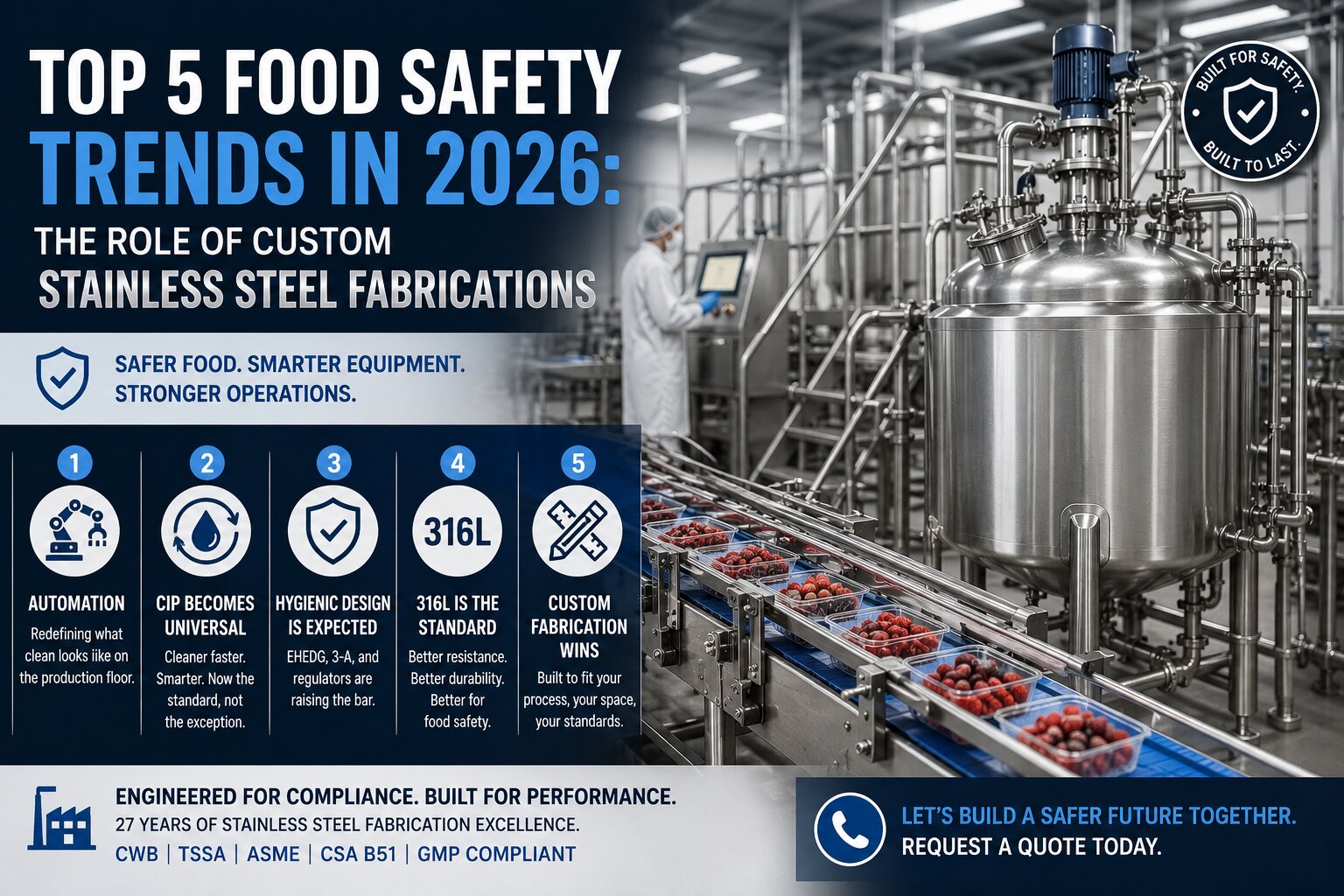
Regulatory standards for food safety have always evolved, but the velocity of change in 2026 is creating measurable risk for processing facilities operating on aging equipment. What’s concerning is how quietly that exposure builds. On the surface, operations look sound. Product is flowing, lines are running, and audits are clearing, with a few exceptions. The problem rarely announces itself before it becomes costly. But underneath that surface-level stability, the standards being applied to food processing equipment have shifted considerably over the past few years, and the equipment in many facilities hasn’t shifted with them.
Hygienic design principles that were once voluntary guidance documents are now embedded in regulatory frameworks and commercial contracts. Material specifications that fabricators used to determine on their own are being written into buyer standards. CIP systems, once a feature worth paying a premium for, are becoming the baseline expectation in sectors that never used to think twice about manual cleaning.
These aren’t emerging trends in the speculative sense. They are already showing up in the RFQs, audit findings, and supplier questionnaires that food processors across North America are dealing with today.
At Ability Fabricators Inc., we’ve spent 27 years in the trenches with food, beverage, and pharmaceutical manufacturers, designing and building the food-grade stainless steel fabrication solutions that keep their operations running.
1. Automation is redefining what clean looks like on the production floor
Robotic systems are now doing a lot of the work that human hands used to do, portioning, filling, sorting, and packaging. That’s reduced contamination risk in some ways. But it’s created a different problem that doesn’t get talked about enough: the equipment those robots work alongside has to be just as hygienically designed as the robots themselves.
A robotic arm operating next to a conveyor full of hard-to-clean crevices is still a contamination liability. The automation investment doesn’t protect you if the surrounding fabrication undermines it.
This is why we’re building more conveyors and platforms than ever with continuous, crevice-free welds and surfaces that cleaning systems can actually reach. When a robotic line runs around the clock with minimal manual cleaning of windows, that design detail stops being a preference and becomes a requirement.
2. CIP is no longer a large-dairy thing - it's becoming universal
Clean-in-Place used to be associated mainly with big dairy or beverage operations. In 2026, we’re having CIP conversations with meat processors, nutraceutical manufacturers, bakery operations, and even dry ingredient facilities.
The case for CIP is simple math. If your tanks need to be disassembled, manually cleaned, reassembled, and revalidated every cycle, you’re losing hours every week and introducing variability into your sanitation outcomes. A properly designed CIP system circulates hot water, caustic, and acid rinses through the vessel in place.
The catch is that the vessel has to be built for it. Internal surface finishes of Ra ≤ 0.8 µm or better. Full-drain base geometry. No dead legs where fluid pools and never gets flushed out. Weld seams are polished to the same standard as the surrounding material. These aren’t features you can bolt onto a tank that wasn’t designed with CIP in mind.
When we design custom food processing tanks for a client today, CIP compatibility is part of the conversation before anything goes to the drawing board.
3. Hygienic design has moved from voluntary guidance to commercial expectation
EHEDG guidelines and 3-A Sanitary Standards have existed for decades. For a long time, many North American processors treated them as aspirational benchmarks, useful references, but not things anyone was really enforcing. That’s changed.
Health Canada, the CFIA, and the FDA have been tightening alignment with these frameworks. More importantly, large grocery retailers and export markets are starting to ask for documentation. Not just assurance, but documentation. Proof that your equipment meets specific hygienic design criteria.
In practical terms, hygienic design principles mean no horizontal ledges where debris and moisture accumulate. No exposed threads or fasteners in the product zone. Welds that are fully fused and ground smooth. Equipment you can clean without taking apart. Every surface, joint, and bracket is treated as a potential contamination point.
Our engineering process builds this review in from the start. Everything that leaves our Toronto food equipment facility is built to GMP standards, and we hold CWB, TSSA, ASME, and CSA B51 certifications.
4. 316L has effectively become the standard for food-contact surfaces
Grade 304 has served the food industry well for a long time. It still has a legitimate place in frames, structural components, and surfaces that never touch the product. But for any surface that comes into direct contact with food, 316L has become the clear choice in food grade stainless steel fabrication, and most serious processors have figured this out by now.
The difference is molybdenum. The 2–3% molybdenum content in 316L gives it meaningfully better resistance to chloride-induced pitting and the gradual surface degradation caused by repeated exposure to cleaning agents and food acids. Pitted surfaces are a food safety problem that cleaning protocols can’t fully solve. Once the pitting is there, bacteria find places to survive that no wash cycle reaches.
316L also handles sodium hypochlorite standard bleach-based sanitizers better than 304 over time, which matters in facilities that sanitize frequently and aggressively.
At AFI, 316L is our default specification for all product-contact surfaces. We provide Material Test Reports with every build so you can verify what you actually received. If a fabricator is quoting you on food processing tanks without specifying material grade or defaulting to 304 on wetted surfaces without explaining why, that’s worth questioning directly.
5. Custom fabrication is winning the argument against off-the-shelf
For a long time, custom fabrication carried a reputation for being expensive and slow. That’s still the perception in some quarters. But the actual economics tell a different story when you factor in what off-the-shelf equipment really costs.
Food processing facilities aren’t built to accommodate catalogue products. They have irregular footprints, GMP zoning constraints, specific gravity-flow requirements in inconvenient places, and process logic that doesn’t map neatly onto what a manufacturer decided to standardize. Forcing a standard product into a non-standard environment creates workarounds, and workarounds create costs, throughput losses, cleaning complications, and regulatory headaches.
Custom food processing tanks built to your exact dimensions, drain geometry, outlet positioning, and process requirements perform better, clean easier, and typically last longer than something that was close but never quite right, especially when paired with compliant CIP systems and proper hygienic design principles.
We handle everything in-house at our Concord facility: concept development, 3D CAD, fabrication, finishing, and delivery. That means fewer handoffs, faster turnaround, and consistent quality across the entire build. It also means if something needs to change during the design process, that conversation happens in one place.
What this adds up to
All five of these trends point in the same direction. The facilities that will perform best over the next decade aren’t just running better protocols; they’re building on better equipment. Hygienically designed stainless steel isn’t a cost center; it’s what makes cleaning faster, audits cleaner, and consistency easier to maintain at scale.
Ability Fabricators has been building custom stainless steel equipment for the food, beverage, and pharmaceutical industries since 1999. If any of what’s described here applies to your current operation, or if you’re just not sure where your equipment stands, we’re happy to have that conversation. Request a quote or reach out directly. The first conversation costs nothing.
Frequently Asked Questions
It’s the design and manufacture of stainless steel equipment tanks, conveyors, hoppers, and blenders built specifically for food production environments. This means appropriate material selection (316L for product-contact surfaces), surface finishes that meet hygienic standards, crevice-free weld design, and compliance with applicable food safety regulations.
CIP circulates cleaning solutions at controlled temperatures, flow rates, and concentrations through the interior of a vessel without disassembly. For it to work properly, the tank needs to be designed with full-drain geometry, smooth internal surfaces, and no dead legs where cleaning fluid can stagnate and leave residue.
CWB for welding, ASME for pressure vessels, TSSA, and demonstrated GMP-standard manufacturing practices. Material traceability through MTRs matters too, particularly in regulated industries where you may need to prove what’s in your equipment.
Proximity matters more than people expect. Local fabricators can make site visits during the design phase, respond faster when questions come up, and manage logistics more efficiently for delivery and installation. AFI works with clients across the GTA and across North America from our Concord, Ontario facility.