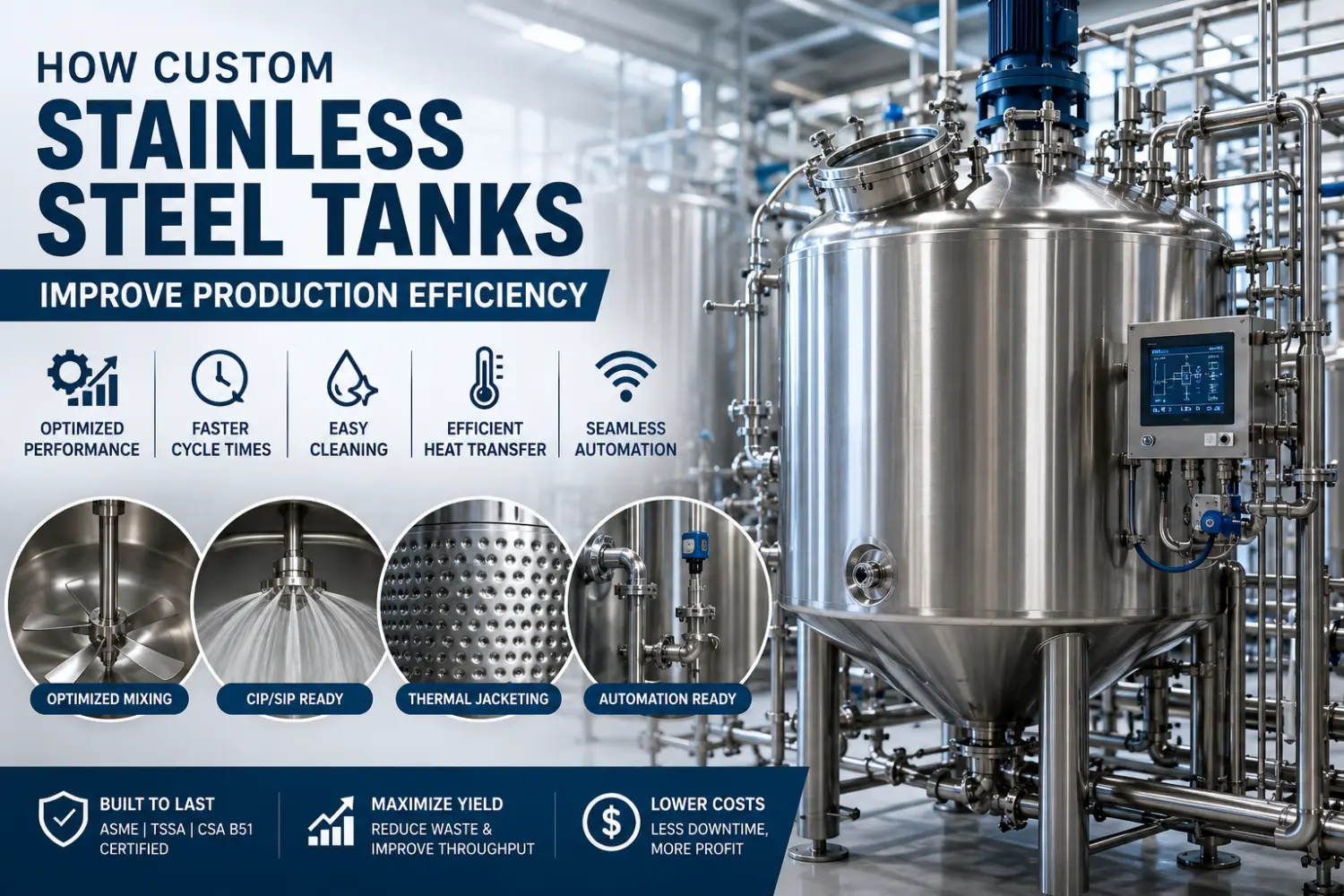
In the world of industrial processing, fluid dynamics, thermal transfer, and mechanical agitation directly affect important metrics of your business. Unfortunately, off-the-shelf vessels often force processing plants to adapt their workflows, constraining their ability to optimize the process. Custom stainless steel tanks can be used to optimize the “hidden” flows of your business by aligning the physical constraints of your infrastructure with the necessary steps for specific chemical and physical processes.
By constructing a vessel to accommodate specific fluid dynamics, flow rates, and facility constraints, a facility can eliminate process constraints. Designing facilities this way has a transformative effect on the output of the facility by focusing on the acceleration of the process rather than simply providing storage for the ingredients.
Why Standard Tanks Often Fall Short
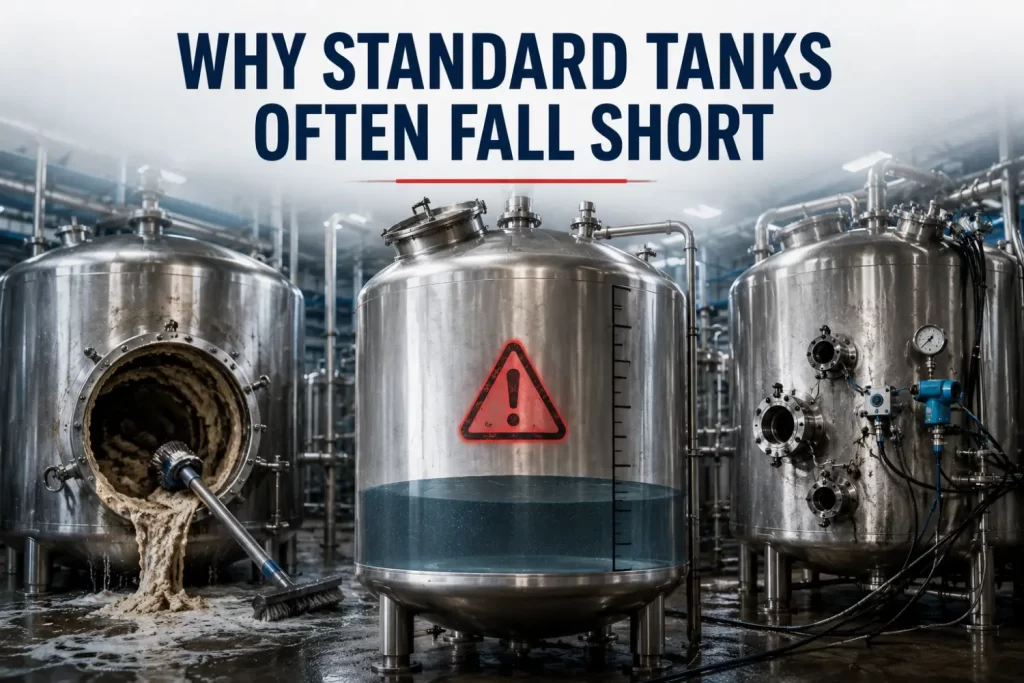
Standard, off-the-shelf tanks are designed for storage. At best, they can accommodate a simple process. However, the application of generic vessels for complex batching, mixing or thermal processing within even mid-sized, high-throughput facilities will create serious issues.
Mismatched Capacity & Wasted Cycles
Typically, a vessel from a standard catalog will not fit the optimal batch size defined by the constraints of the raw material supply or the processes at the downstream end performed by packaging. A vessel that is too small will force the need to perform several partial batches, each of which will require a significant investment of time and the repeated clearing and testing of the raw materials. An oversized vessel will require running small batches, and will result in poor contact leading to underperformance of the heating surfaces or impellers, and inadequate consistency of the resulting product.
Poor Cleaning Access Increasing Downtime
Standard tanks are designed with basic geometric configurations and do not accommodate the specific rheology of the processed material. Standard vessels retain a significant amount of material processing residue and lead to increased downtime due to the need for more frequent and prolonged cleaning. Tank designs without sanitary features force cleaning through long chemical wash cycles, confined-space entry, and manual scrubbing, all of which impact overall plant availability.
Design Limitations of Automation Integration
The modern process employs real-time data from load cells, turbidity, and automated flow control valves. Most readily available tanks do not have port configurations that support modern instrumentation. Field modification of a generic tank to add ports for instrumentation can distort the tank, compromise the integrity of the welds, and breach the certification of the pressure vessel. This lack of integration requires operations to rely on manual monitoring, which increases error and delays reaction time.
5 Ways Custom Tanks Drive Efficiency
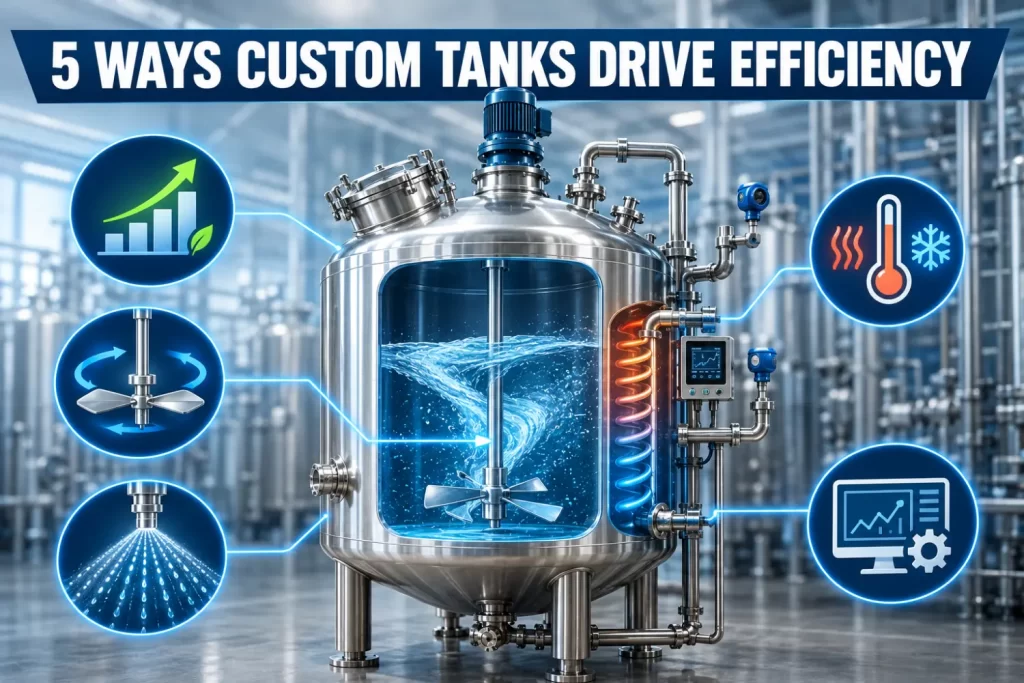
Industrial tank fabrication provides process engineers the flexibility of tank design with no structural compromises. This engineering freedom yields five distinct custom tank design benefits:
1. Reduced Batch Waste With Custom Fit Capacity
Custom stainless steel tanks can be designed with consideration to the exact volumetric needs of the process chemistry and the constraints of the upstream supply. The design of custom tanks enables the elimination of unused dead space. The heel (the unusable product left in the tank after draining) can be minimized with the optimization of the fluid level.
2. Perfected Agitation and Mixing
The design of custom tanks allows consideration of the optimal design of tank mixing and agitation based on the physical relationship of the diameter of the tank to the height of the liquid and impeller design.
[Aspect Ratio: Height-to-Diameter]
│
├──► Low Viscosity Fluids: Taller, narrower vessels promote axial flow
└──► High Viscosity Fluids: Wider vessels prevent stagnant peripheral zones
Proper positioning of internal baffles prevents vortexing and ensures rapid homogenization, which directly increases stainless steel tank throughput by cutting cycle times.
3. CIP/SIP-Ready Design Cuts Cleaning Downtime
Sanitary processing requires rapid, verifiable sanitation protocols. Custom industrial tank fabrication allows for the integration of precisely positioned spray balls that deliver complete coverage of all internal surfaces without shadowing. Eliminating interior crevices, using high-grade finishes, and utilizing radius corners ensures that cleaning fluids drain completely and rapidly.
How CIP Design Reduces Turnaround Time Between Batches
Clean-in-place (CIP) efficiency relies on mechanical action, chemical concentration, temperature, and time. When a tank is custom engineered for CIP, internal surfaces feature smooth orbital welds and a minimum 2B or mirror finish. This reduces the mechanical adhesion of the product to the steel. Consequently, automated wash cycles can use less water and fewer chemicals while achieving full sterilization in a fraction of the time required for a standard tank.
4. Integrated Thermal Jacketing for Faster Heat Transfer
Whether a process requires steam heating or glycol cooling, heat transfer efficiency depends on surface area and fluid velocity within the jacket. Custom vessels can feature dimple jackets, half-pipe coils, or full conventional jackets tailored to the temperature profile of the specific utility supply.
- Dimple Jacket: Best for high pressure, high turbulence, efficient thin-wall heat transfer
- Half-Pipe Coil: Excellent for high temperature thermal oils, targeted heating zones
By matching the jacket configuration to the product’s thermal properties, facilities achieve rapid batch heat-up and cool-down targets, preventing thermal degradation.
5. Custom Fittings & Ports for Seamless Automation Integration
A custom vessel accommodates precise sensor placement. Level transmitters, temperature probes, and pressure transducers can be positioned exactly where they yield the most accurate process data. Custom-machined tri-clamp or flanged connections ensure leak-free operation and rapid sensor removal for calibration, allowing automated control systems to adjust process variables instantaneously without manual intervention.
Real-World Impact: Efficiency Gains by Industry
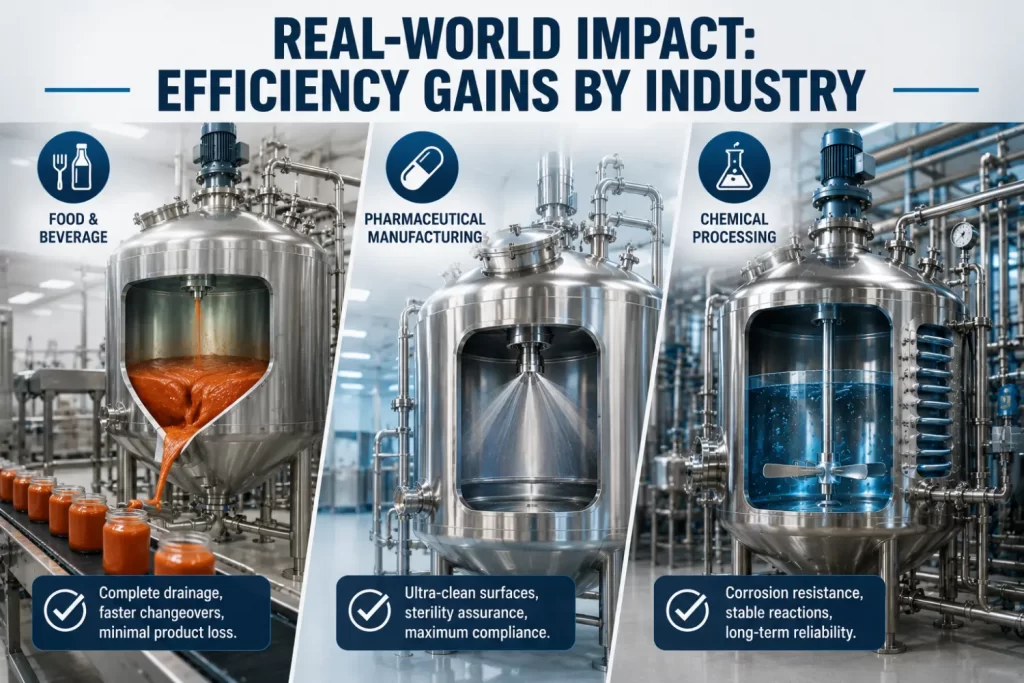
The adoption of production efficiency stainless steel tanks delivers distinct operational advantages depending on the specific compliance and manufacturing demands of the sector.
Food & Beverage Processing
In the food and beverage sector, preventing batch cross-contamination while maintaining high volume output is critical. Custom tanks feature specific bottom cone angles, typically 45 or 60 degrees, to ensure complete drainage of viscous products like sauces, purees, or dairy bases. This rapid discharge speeds up packaging lines and minimizes product loss during batch changeovers.
Pharmaceutical Manufacturing
Pharmaceutical processes demand absolute sterility and compliance with stringent sanitary standards. Custom vessels for this industry utilize 316L stainless steel with electropolished interior surfaces down to a low roughness average (Ra). These ultra-smooth surfaces prevent bacterial attachment and biofilm formation, ensuring rapid validation during steam-in-place (SIP) cycles and maximizing overall equipment effectiveness.
Chemical Processing
Chemical manufacturing frequently involves aggressive reagents, exothermic reactions, and high pressures. Custom industrial tank fabrication ensures the correct wall thickness and material composition, such as specialty alloys, to withstand corrosive environments. Tailored heat transfer surfaces prevent localized overheating, stabilizing chemical reactions and protecting product integrity.
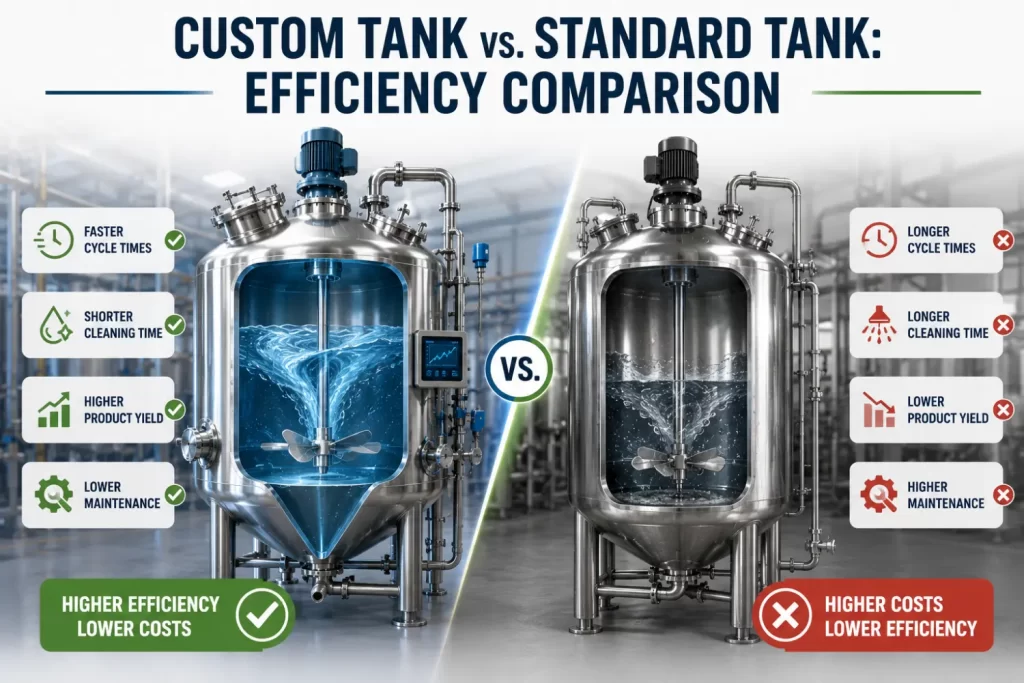
Custom Tank vs. Standard Tank: Efficiency Comparison
|
Operational Metric |
Standard Storage Tank |
Custom Process Vessel |
|
Cycle Time |
Extended due to suboptimal mixing and unrated thermal transfer surfaces. |
Accelerated via custom-matched impellers and high-efficiency heat jackets. |
|
Cleaning Time |
Long manual wash cycles or multi-stage CIP due to surface shadows and crevices. |
Short, automated CIP cycles achieved through optimized spray ball placement and high-grade finishes. |
|
Product Yield |
Higher product loss from large fluid heels and material sticking to unpolished walls. |
Maximum yield through steep cone bottoms and low-friction, electropolished interiors. |
|
Maintenance Requirements |
Frequent downtime to replace generic seals or repair field-modified ports. |
Minimal maintenance with long-lasting, process-matched components and certified factory welds. |
Practical Implications of the Comparison
The performance differences highlighted in the table directly influence facility profitability. While a standard tank has a lower initial purchase price, its operational inefficiencies accumulate ongoing costs. Extended cleaning windows reduce the total number of batches a facility can run per week, cutting down long-term stainless steel tank throughput.
Furthermore, poor product yield translates to raw materials being washed down the drain during every turnaround cycle. The engineering choices integrated into a custom vessel eliminate these hidden operational costs, providing superior lifecycle value and a faster return on investment.
Signs Your Current Tank Setup Is Costing You Efficiency
Many processing plants tolerate hidden losses simply because their equipment has always operated that way. Knowing these signs will tell you when an upgrade is needed.
- Frequent Downtime for Manual Cleaning: If your production is constantly disrupted for your cleaning staff to manually scrub the tank interiors or clear the outlet ports, you have an inefficient cleaning process instead of relying on production efficiency stainless steel tanks.
- Inconsistent Batch Quality: If you have inconsistent mixing and dead zones in your vessel, you may notice a difference in the texture and color of your product or even the concentration of active ingredients.
- Bottlenecks During Peak Production: If your downstream packaging lines are waiting for a tank to finish its heating, cooling, or draining cycle, then your vessel is most likely creating a bottleneck concerning the thermal and physical limits of the plant.
How AFI Designs Tanks for Maximum Efficiency
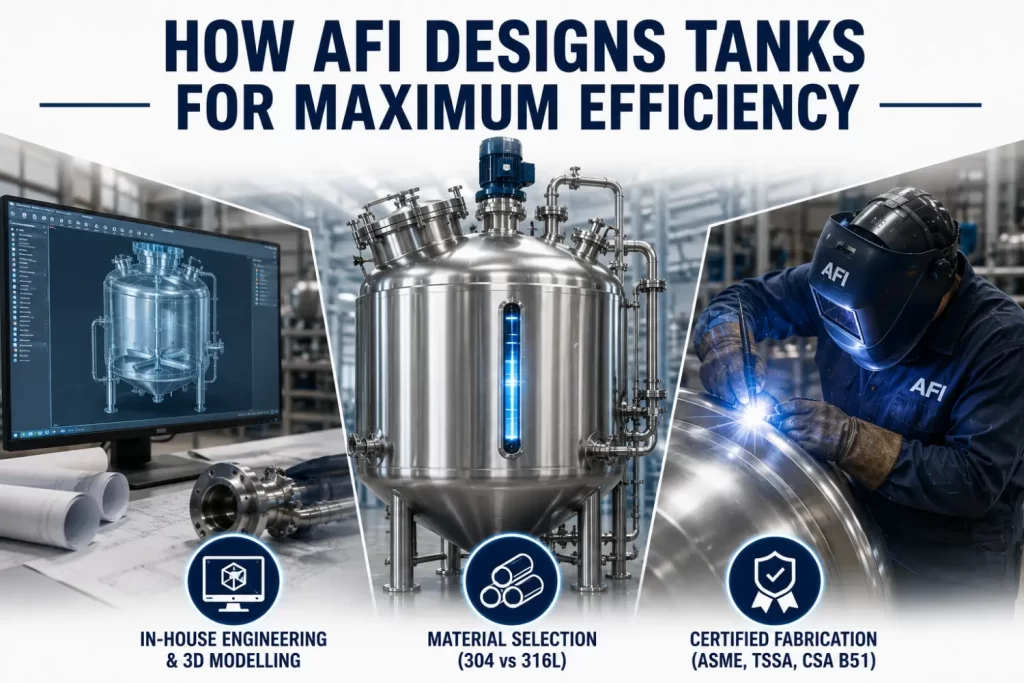
AFI specializes in design and manufacturing to deliver effective and innovative fluid-handling solutions to relieve process constraints. With the ability to combine fluid mechanics with the science of fabrication, AFI is able to design and manufacture custom stainless steel tanks to optimize your plant workflow.
In-House Engineering & 3D Modelling
AFI’s process begins with comprehensive in-house engineering. With the aid of cutting-edge 3D modeling software, AFI’s engineering staff is able to map out the tank’s ports, baffles, jacket passes, and impeller clearances. With this software, AFI’s engineering team is able to ensure that the tank will fit within the constraints of the plant’s existing infrastructure, piping, and automation.
Material Selection (304 vs 316L) for Process-Specific Needs
AFI strives to balance the cost and life cycle of the tank. AFI assesses your process chemistry, concentrations, and temperatures to determine the best material grade for your application.
- Grade 304 Stainless Steel: This option has excellent strength and corrosion resistance for normal levels in the food and beverage industries, as well as light industrial use.
- Grade 316L Stainless Steel: This alternative features molybdenum along with a lower carbon content, so it resists pitting and corrosion better than 304 in high chloride, acidic, and very sterile environments such as pharmaceuticals and specialty chemicals.
Certified Fabrication (ASME, TSSA, CSA B51)
Quality assurance at AFI is fortified with extensive industry certifications. Vessels undergo strict industrial tank fabrication in compliance with ASME Section VIII, Division 1 standards, ensuring pressure containment safety.
Local compliance and pressure boundary integrity are maintained through adherence to TSSA and CSA B51 regulations. Every weld is inspected, documented, and pressure-tested, giving plant managers complete confidence in the structural reliability of their custom equipment.
Faqs
Efficiency gains depend on the shortcomings of the existing system. However, by leveraging custom tank design benefits like optimized heat transfer surfaces and agitation geometry, facilities regularly see batch cycle times drop significantly. Reductions in CIP turnaround time also allow plants to fit more production cycles into the same working week.
Yes. Small-batch production often involves high-value ingredients or frequent product changeovers. A custom tank minimizes product loss from fluid heels and speeds up the sanitation process between distinct product runs, directly protecting small-batch margins.
Timeline varies based on vessel complexity, size, and current material availability. The process typically requires several weeks for engineering design, 3D model approval, material procurement, certified welding, surface finishing, and quality control testing. AFI provides transparent schedule estimates during the initial consultation.
Some modifications are possible, such as retrofitting a more efficient agitator assembly or updating CIP spray balls. However, modifying pressure boundaries or adding internal heating jackets to an existing unrated tank can compromise structural integrity and void regulatory certifications. In most cases, a new, custom-engineered vessel delivers superior long-term ROI.